
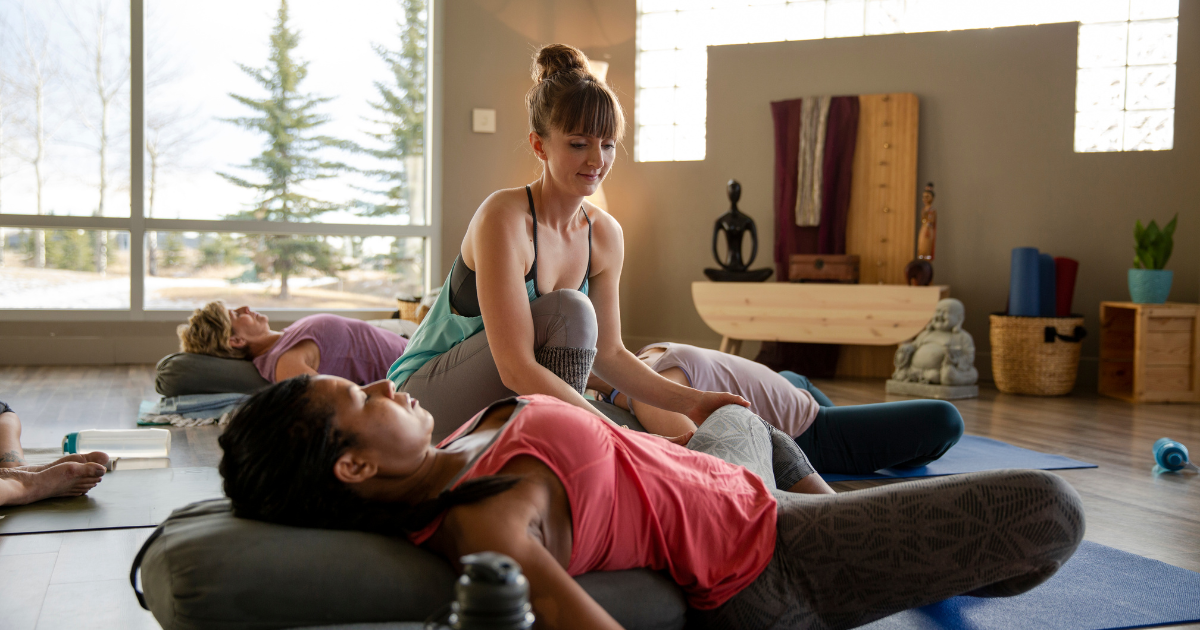
Restorative yoga can look deceptively simple. Students settle into supported poses, the lights are dimmed, and the room becomes quiet. But creating a restorative practice takes more than putting out a few bolsters and blankets. Each pose requires thoughtful setup, appropriate support, and enough time for students to settle in comfortably. As a teacher, your attention shifts from leading movement to observing the room and making small adjustments when needed.
And you don't need an entire studio of props to do it well. Here are four ways to approach restorative yoga with greater intention and flexibility.
1. Make support the foundation of every pose
In restorative yoga, props help support the body so students can spend less effort maintaining a position.
Pay attention to how students are settling into each pose. Are their shoulders relaxed? Are they holding tension in their jaw? Are their legs shifting because they haven't found a comfortable position?
Sometimes a small adjustment makes a meaningful difference. A folded blanket beneath the knees, additional support beneath the head, or a change in the angle of a bolster can help a student find a more comfortable position.
Give students time to settle before moving on. Check in, offer adjustments when appropriate, and remind them that they can change their position whenever they need to.
2. Learn to work with what you have
A studio filled with bolsters, blocks, and blankets offers plenty of possibilities, but restorative yoga doesn't depend on having professional equipment.
Think in terms of high-prop and low-prop options.
A high-prop variation of a supported reclined pose might use a bolster along the spine, blocks beneath the thighs, and a folded blanket under the head.
A low-prop variation might use a firm couch cushion, a rolled towel, and a wall for additional support.
Learning to teach both approaches gives you more flexibility as a teacher. It also makes it easier to share practices students can recreate at home or in spaces where traditional yoga equipment isn't available.
The important part isn't how many props you use. It's understanding what each prop contributes and how to arrange support for the individual student.
3. Choose fewer poses and give them more time
Restorative classes generally include fewer poses than a typical movement-based class. Rather than moving quickly from one shape to another, allow students several minutes to settle into each position.
Transitions deserve just as much attention as the poses themselves. Give clear, simple instructions before students begin moving, and allow enough time for them to reposition themselves without feeling rushed.
A well-planned class doesn't need a long list of poses to feel complete. Thoughtful sequencing, comfortable support, and unhurried transitions can create a cohesive experience.
4. Adapt the practice to the season and the students
The environment and the people in the room both influence how you plan a restorative class.
During colder months, you might offer additional blankets, warmer layers, and more fully supported reclined positions. In warmer weather, you might keep the room lighter and offer a different selection of supported shapes.
Just as importantly, consider the individual needs of your students.
Not everyone is comfortable lying flat on their back or getting down onto the floor. A seated position, an elevated torso, or additional support beneath the legs may offer a more appropriate starting point.
Give students options and encourage them to communicate what feels comfortable. Restorative teaching is less about getting everyone into the same pose and more about understanding how to make each position work for the person practicing it.
A practice to bring into your next class
Choose one restorative pose and plan two different setups: one using all the props available in your studio, and another using only a blanket and a wall.
Try teaching the low-prop version and invite students to explore how they might recreate the setup at home.
Then experience it yourself. Lie on your back with your legs resting against a wall, or place your lower legs on the seat of a chair. Add a folded blanket beneath your head if needed, and spend five minutes noticing how the different points of support feel.
Consider what you might adjust to make the position more comfortable.
Sometimes, learning to teach restorative yoga starts with learning how to receive support yourself.
Related reading from our sister school, NESBEM: What Changes When We Stop Being In Nature and Start Being With Her.