
Yoga and Bone Health: What a Decade of Research on Osteoporosis Actually Shows
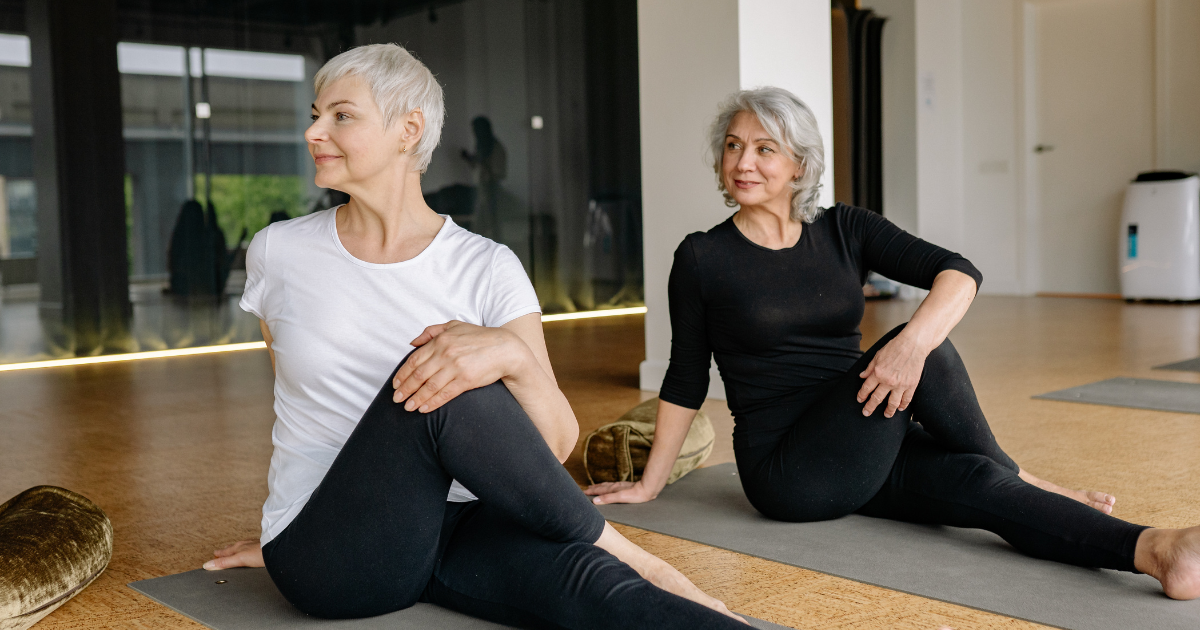
If you teach older adults, someone has almost certainly asked you whether yoga can help with osteoporosis. It is a question worth taking seriously, and the most substantial answer we have comes from a study that ran, patiently, for a full decade.
Dr. Loren Fishman, a physiatrist at Columbia University, began recruiting participants in 2005 for a study on a 12-minute daily yoga regimen: twelve poses, held for 30 seconds each, chosen specifically for their calculated effect on bone density at the spine, hip, and femur. By the time the study closed in 2015, 741 people had joined; 227 stayed compliant more often than every other day, and 174 of those, 83%, already had osteopenia or osteoporosis when they enrolled (Lu, Rosner, Chang & Fishman, 2015).
The most rigorous slice of the data comes from the 43 participants who stayed moderately to fully compliant and had complete bone density scans, before and after, using DXA imaging, the same standard used in a clinical osteoporosis diagnosis. Among this group, the researchers reported improvements in bone mineral density at the spine, hip, and femur. A smaller group of 18 participants also underwent a more detailed bone-quality assessment using high-resolution imaging of the hip.
It is worth naming clearly what this study is and is not, because that clarity is part of what makes it trustworthy. It was not a randomized controlled trial; it compared each participant's bone density before and after they began the practice, rather than against a separate group who did not practice yoga at all. The fully-documented, compliant group of 43 is a small fraction of the 741 who originally joined. These are real limitations, and they are part of why Fishman's team has kept studying the question rather than calling it settled. But within those limits, a decade-long, carefully measured study finding improved bone density in a population where 83% already had diagnosed bone loss is a meaningfully different claim than a vague sense that "yoga is good for your bones." It is evidence that a specific, structured practice, done consistently, may do something real, for a specific population, and that consistency, more than intensity, was the variable that mattered most.
For a yoga therapist or teacher working with clients managing osteopenia or osteoporosis, the takeaway is not "prescribe yoga for bone density." It is that thoughtful pose selection, careful alignment, and a sustained daily practice, even one as modest as 12 minutes, are worth taking seriously as part of a bone health plan built in coordination with a client's physician, not as a replacement for one.
Prema Yoga Institute's curriculum includes Yoga for Osteoporosis as an elective within the broader Yoga Therapy Certification track, alongside the anatomical grounding needed to teach it with real care. Explore PYI's course offerings.
Interested In Learning More About Our Yoga Therapy Certification? Click here.

What Is a Yoga Therapist? Understanding the Path from RYT to C-IAYT

"It's all yoga. The difference is in the application," says Mary Northey, Dean of the Kripalu School of Integrative Yoga Therapy, describing the line between a yoga teacher and a yoga therapist (Kripalu). It is a generous way to put it, and a good place to start, because the confusion between these two roles is common, and getting clear on it can save you real time and money as you plan your own next step.
A 200-hour yoga teacher certification prepares you to hold a room well: sequencing a class, pacing it, keeping a group of students with a shared general goal safe and supported. A yoga therapist does something different in kind, not just in degree. They sit with one person at a time, usually around a specific concern, chronic pain, anxiety, a cardiac condition, recovery from injury, and they build a practice around that person's actual body and actual life, not a general class plan. It is a more intimate, more accountable kind of work, and it asks more of the person doing it.
That is why the training requirement grows the way it does. Where a teacher certification asks for 200 hours, a yoga therapist typically needs 1,000: the original 200-hour teacher training plus 800 more hours covering advanced anatomy and physiology, working knowledge of disease and mental health conditions through a Western clinical lens, and, in most accredited programs, roughly 150 hours of supervised clinical experience with real clients (Kripalu). Those extra hours are what let a yoga therapist sit across the table from a referring physician, physical therapist, or mental health provider and be taken seriously as a partner in someone's care, not just an adjacent practice they happen to also be doing.
The credential that marks this level of training is C-IAYT, certification through the International Association of Yoga Therapists. IAYT built it so that yoga therapists meeting a rigorous, peer-reviewed standard would be recognized both within the yoga tradition they come from and by the healthcare professionals they increasingly work alongside (IAYT). It exists because this field is being asked, more and more, to show its work: through intake assessments, clearly stated goals, and outcomes tracked over the life of a client relationship, not just a sense that someone felt better.
None of this makes a yoga therapist a diagnostician or a stand-in for medical care, and it shouldn't. Their role, as Kripalu describes it, is to act as "a guide or mentor" on a client's path, offering tools when the client is ready for them, and staying present as their healing unfolds rather than directing it from above. But holding that role responsibly takes real training, which is exactly what the 1,000-hour path and C-IAYT certification exist to provide.
If you already hold a 200-hour or 300-hour certification and are wondering what comes next, Prema Yoga Institute's IAYT-accredited Yoga Therapy Certification is built around this exact pathway, and we would be glad to walk you through it. See current program details and start dates.
Interested In Learning More About Our Yoga Therapy Certification? Click here.

Ayurvedic Yoga Teacher Training: How Understanding the Doshas Makes You a Better RYT 500 — and Opens the Door to Yoga Therapy

If you've completed your 200-hour yoga teacher training and you're asking yourself what comes next, you've probably already sensed that the answer isn't just more hours. It's more depth. The jump from RYT 200 to RYT 500 isn't only about accumulating advanced credentials — it's about fundamentally changing the way you see your students, understand the body, and design a practice that actually meets people where they are.
That shift is exactly what Ayurvedic yoga teacher training offers.
Ayurveda — the ancient Indian sister science of yoga — gives teachers and yoga therapists a framework for understanding every student as a unique individual, shaped by the interplay of five elements and three doshas: Vāta, Pitta, and Kapha. Learning to see through this lens is one of the most transformative skills taught in advanced 300-hour yoga teacher training programs and IAYT-accredited yoga therapy certification programs alike.
At Prema Yoga Institute, our online Ayurvedic yoga teacher training weaves Ayurveda throughout both our RYT 500 track and our full yoga therapy certification program — because this is where yoga instruction becomes yoga therapy, and where teachers become truly skilled practitioners.
“🌿 What Is Ayurvedic Yoga Teacher Training?
Ayurvedic yoga teacher training integrates the principles of Ayurveda — India’s classical system of medicine — with advanced yoga education. Rather than teaching one sequence to all students, Ayurvedic-informed teachers learn to personalize practice based on a student’s constitution, current condition, season, and life stage. This approach is central to IAYT-accredited yoga therapy programs and increasingly sought after by RYT 200 teachers pursuing their 500-hour designation.”
Why Doshas Matter to Every Yoga Teacher — Not Just Yoga Therapists
One of the most common misconceptions about Ayurvedic yoga training is that it's only relevant if you're pursuing a formal yoga therapy certification. In reality, the dosha framework is a practical, immediately applicable teaching tool for any yoga teacher working with real students in real classes.
The three doshas — Vāta, Pitta, and Kapha — are Ayurveda's way of describing how different combinations of the five elements (ether, air, fire, water, and earth) express themselves in human beings. Each dosha has a characteristic way of moving through the world, a characteristic set of strengths, and a characteristic pattern of imbalance.
In Ayurvedic yoga therapy, we focus on a student's Vikruti — their current condition and present imbalance — rather than their Prakruti, or birth constitution. This distinction is what transforms a yoga class into a truly therapeutic experience, and it is a foundational skill for anyone pursuing the C-IAYT credential or an advanced RYT 500 designation with a therapeutic focus.
Vāta: Teaching the Visionary, Anxious Learner
Governed by Air and Ether, Vāta is the dosha of movement, creativity, and change. Your Vāta students are the visionaries — quick, intuitive, and full of ideas. They learn fast. They also forget fast. When out of balance, Vāta presents as anxiety, overwhelm, poor sleep, scattered focus, and a body that feels untethered.
As a yoga teacher or yoga therapist, recognizing Vāta vitiation in a student changes everything about your prescription.
Teaching & Therapy Approach for Vāta
Asana: Slow, grounding, earth-connecting practices — Restorative Yoga, long-held Hatha poses, forward folds, and postures close to the floor (Bālāsana, Kurmāsana). These help Vāta students settle into their bodies and relate to the material world.
Prāṇāyāma: Slow, rhythmic breathing to activate apāna (downward-flowing energy). Rapid or irregular breathing techniques will intensify Vāta's already spinning quality.
Therapeutic touch: Hands-on assists and grounding contact are profoundly beneficial for Vāta types, who often struggle to feel physically present.
Your goal: Create containment. Meditation, ritual, and consistent structure are as therapeutic as any posture.
Pitta: Teaching the Driven, Overheated Achiever
Pitta combines Fire and Water into the dosha of transformation, focus, and ambition. Pitta students are your natural leaders — articulate, disciplined, and often the first to master a new pose. They're also the most likely to push through pain, compete with the person on the next mat, and leave class more wound up than when they arrived.
When Pitta vitiates, that fire becomes temper, impatience, perfectionism, and burnout. For yoga teachers training toward an RYT 500 or yoga therapy credential, learning to recognize and cool an overheated Pitta student is one of the most clinically relevant skills you can develop.
Teaching & Therapy Approach for Pitta
Asana: Alignment-based practices that invite precision without competition. Yin Yoga and Iyengar-informed work are ideal. Actively discourage hot Vinyasa and heated classes for Pitta students, especially during summer when the environment amplifies their dosha.
Prāṇāyāma: Cooling breath practices — Sītalī and Sītkārī — are the prescription. Kapālabhāti and other heating techniques should be used carefully, as they can tip an already-fiery Pitta into agitation.
Meditation: Pitta students need practices that shift their attention inward and dissolve the self-critical, competitive voice. Loving-kindness and non-striving meditations are powerful.
Your goal: Cool the fire. The most effective yoga therapy intervention for Pitta is often permission to stop pushing.
Kapha: Teaching the Steady, Stagnant Nurturer
Earth and Water make Kapha the dosha of stability, endurance, and deep loyalty. Kapha students are often the warmest people in the room — patient, devoted, and grounding for everyone around them. When in balance, they are a gift. When out of balance, they become heavy, stagnant, and resistant to change. A Kapha in vitiation may appear emotionally flat, physically sluggish, or unmotivated to practice at all.
For RYT 500 teachers and yoga therapy practitioners, learning to meet Kapha with compassionate challenge — rather than more grounding — is a key skill.
Teaching & Therapy Approach for Kapha
Asana: Dynamic, energizing, heat-building practices — Vinyasa, power yoga, Mysore-style Ashtanga, arm balances, and inversions. These counter stagnation and stimulate the upward-moving energy Kapha lacks.
Prāṇāyāma: Kapālabhāti and Breath of Fire — stimulating, upward-tending techniques that kindle agni (digestive fire) and counteract Kapha's heaviness.
Important nuance: While Restorative and grounding practices are not the primary Kapha prescription, they hold a special place for Kapha types who often spend their lives caring for everyone else. Permission to receive — to be held rather than to hold — can be its own therapeutic intervention.
Your goal: Create momentum. Encourage warmth. Challenge them lovingly out of comfortable stagnation.
Applying the Doshas in Group Classes vs. One-on-One Yoga Therapy
One of the most practical questions in Ayurvedic yoga teacher training is how to use all of this in a room full of different people with different constitutions. The answer is nuanced and important.
“📌 Group Classes: Mildly Medicinal, Always Grounding
In a group setting, you cannot address every student’s individual Vikruti — that is the work of one-on-one yoga therapy. Instead, design classes to be “mildly medicinal”: responsive to the season, the time of day, and the collective energy in the room. Every class, regardless of style or dosha emphasis, should leave students more grounded at the end than they were at the beginning. This is a non-negotiable principle in Ayurvedic yoga therapy training.”
One-on-one yoga therapy sessions, by contrast, allow you to work directly with a student's Vikruti — building a personalized practice prescription over time. This is the level of work taught in IAYT-accredited yoga therapy programs like Prema Yoga Institute's 500-hour certification.
Who This Training Is For
Ayurvedic yoga teacher training at PYI is designed for three overlapping audiences:
RYT 200 teachers: pursuing their 300-hour training and RYT 500 designation with a therapeutic and philosophical foundation
Yoga teachers: drawn to Ayurveda who want to bring a personalized, whole-person approach to their classes and private clients
Practitioners: on the path to IAYT yoga therapy certification who want to integrate Ayurveda as a core clinical framework
All of PYI's programs are offered fully online with live faculty sessions, making them accessible to yoga teachers throughout New York City, New Jersey, Connecticut, and nationwide. Our modular structure means you can complete your 300-hour Ayurvedic yoga teacher training on a schedule that fits a working teacher's life.
“→ Ready to Advance From RYT 200 to RYT 500 — With an Ayurvedic Foundation?
Prema Yoga Institute’s online 300-hour yoga teacher training counts toward both your Yoga Alliance RYT 500 designation and your IAYT yoga therapy certification hours. Study with world-class faculty including C-IAYT yoga therapists, physicians, and Ayurvedic specialists. Live online sessions available for students in New York, New Jersey, Connecticut, and beyond.”
Care to learn more about Ayurveda? Our Ayurvedic Yoga Therapy Training is offered every year as part of our Yoga Therapy Certification and 300 hour Yoga Alliance Certification. Check it out here!
Please note that blogs do not constitute or replace medical advice.