
Yoga and Bone Health: What a Decade of Research on Osteoporosis Actually Shows
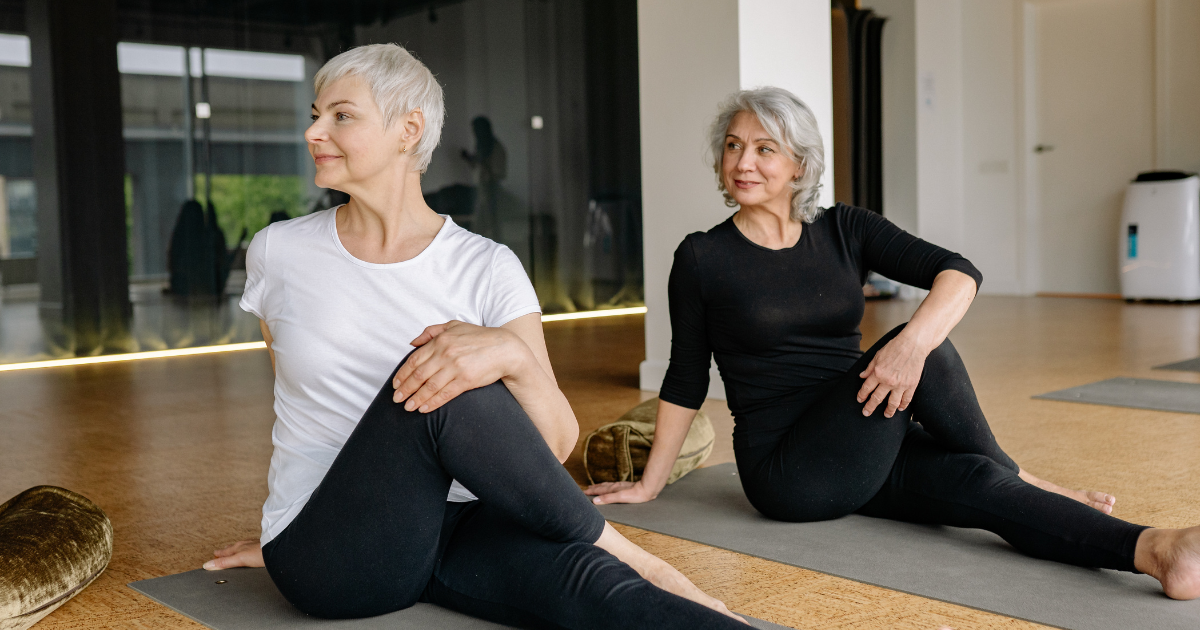
If you teach older adults, someone has almost certainly asked you whether yoga can help with osteoporosis. It is a question worth taking seriously, and the most substantial answer we have comes from a study that ran, patiently, for a full decade.
Dr. Loren Fishman, a physiatrist at Columbia University, began recruiting participants in 2005 for a study on a 12-minute daily yoga regimen: twelve poses, held for 30 seconds each, chosen specifically for their calculated effect on bone density at the spine, hip, and femur. By the time the study closed in 2015, 741 people had joined; 227 stayed compliant more often than every other day, and 174 of those, 83%, already had osteopenia or osteoporosis when they enrolled (Lu, Rosner, Chang & Fishman, 2015).
The most rigorous slice of the data comes from the 43 participants who stayed moderately to fully compliant and had complete bone density scans, before and after, using DXA imaging, the same standard used in a clinical osteoporosis diagnosis. Among this group, the researchers reported improvements in bone mineral density at the spine, hip, and femur. A smaller group of 18 participants also underwent a more detailed bone-quality assessment using high-resolution imaging of the hip.
It is worth naming clearly what this study is and is not, because that clarity is part of what makes it trustworthy. It was not a randomized controlled trial; it compared each participant's bone density before and after they began the practice, rather than against a separate group who did not practice yoga at all. The fully-documented, compliant group of 43 is a small fraction of the 741 who originally joined. These are real limitations, and they are part of why Fishman's team has kept studying the question rather than calling it settled. But within those limits, a decade-long, carefully measured study finding improved bone density in a population where 83% already had diagnosed bone loss is a meaningfully different claim than a vague sense that "yoga is good for your bones." It is evidence that a specific, structured practice, done consistently, may do something real, for a specific population, and that consistency, more than intensity, was the variable that mattered most.
For a yoga therapist or teacher working with clients managing osteopenia or osteoporosis, the takeaway is not "prescribe yoga for bone density." It is that thoughtful pose selection, careful alignment, and a sustained daily practice, even one as modest as 12 minutes, are worth taking seriously as part of a bone health plan built in coordination with a client's physician, not as a replacement for one.
Prema Yoga Institute's curriculum includes Yoga for Osteoporosis as an elective within the broader Yoga Therapy Certification track, alongside the anatomical grounding needed to teach it with real care. Explore PYI's course offerings.
Interested In Learning More About Our Yoga Therapy Certification? Click here.

What Is a Yoga Therapist? Understanding the Path from RYT to C-IAYT

"It's all yoga. The difference is in the application," says Mary Northey, Dean of the Kripalu School of Integrative Yoga Therapy, describing the line between a yoga teacher and a yoga therapist (Kripalu). It is a generous way to put it, and a good place to start, because the confusion between these two roles is common, and getting clear on it can save you real time and money as you plan your own next step.
A 200-hour yoga teacher certification prepares you to hold a room well: sequencing a class, pacing it, keeping a group of students with a shared general goal safe and supported. A yoga therapist does something different in kind, not just in degree. They sit with one person at a time, usually around a specific concern, chronic pain, anxiety, a cardiac condition, recovery from injury, and they build a practice around that person's actual body and actual life, not a general class plan. It is a more intimate, more accountable kind of work, and it asks more of the person doing it.
That is why the training requirement grows the way it does. Where a teacher certification asks for 200 hours, a yoga therapist typically needs 1,000: the original 200-hour teacher training plus 800 more hours covering advanced anatomy and physiology, working knowledge of disease and mental health conditions through a Western clinical lens, and, in most accredited programs, roughly 150 hours of supervised clinical experience with real clients (Kripalu). Those extra hours are what let a yoga therapist sit across the table from a referring physician, physical therapist, or mental health provider and be taken seriously as a partner in someone's care, not just an adjacent practice they happen to also be doing.
The credential that marks this level of training is C-IAYT, certification through the International Association of Yoga Therapists. IAYT built it so that yoga therapists meeting a rigorous, peer-reviewed standard would be recognized both within the yoga tradition they come from and by the healthcare professionals they increasingly work alongside (IAYT). It exists because this field is being asked, more and more, to show its work: through intake assessments, clearly stated goals, and outcomes tracked over the life of a client relationship, not just a sense that someone felt better.
None of this makes a yoga therapist a diagnostician or a stand-in for medical care, and it shouldn't. Their role, as Kripalu describes it, is to act as "a guide or mentor" on a client's path, offering tools when the client is ready for them, and staying present as their healing unfolds rather than directing it from above. But holding that role responsibly takes real training, which is exactly what the 1,000-hour path and C-IAYT certification exist to provide.
If you already hold a 200-hour or 300-hour certification and are wondering what comes next, Prema Yoga Institute's IAYT-accredited Yoga Therapy Certification is built around this exact pathway, and we would be glad to walk you through it. See current program details and start dates.
Interested In Learning More About Our Yoga Therapy Certification? Click here.

Prema Yoga Institute Is Now Part of a Larger Home for Bioenergetic Medicine

Prema Yoga Institute has spent over a decade building one of the most respected yoga therapy trainings in the country, IAYT-accredited, evidence-informed, and grounded in the work Dana Slamp built starting in 2012. That foundation is not changing. What is changing, and what we are glad to share, is the company PYI now keeps.
PYI is becoming a sister institution to the New England School of Bioenergetic Medicine (NESBEM). If you have not come across NESBEM yet, it is a professional training institution devoted to bioenergetic medicine: the study and practice of how a person's physical, mental, emotional, and energetic systems work together to create health, or to break down when they fall out of coherence with one another. Like PYI, NESBEM trains practitioners, not hobbyists, and it takes the science behind its methods just as seriously as PYI always has. It also trains something broader: leaders and change agents equipped to carry this work into the wider world, not just into a treatment room.
This is more than an announcement, it changes something for the better. Yoga therapy has always been a bioenergetic practice, even before anyone in the yoga world used that word for it. Every breath pattern, every pose, every technique a yoga therapist uses to calm an overwhelmed nervous system is, in NESBEM's language, a way of restoring coherence between a person's body, mind, and the energetic systems that keep them well. Bringing these two institutions together under one roof means PYI students and graduates now have access to a wider curriculum, additional faculty, and a broader community of practitioners who share this same underlying belief: that the body's own intelligence, properly supported, is the most powerful tool either school can teach a practitioner to work with.
For current students and graduates, this means you now have a real, accessible path to build on your yoga therapy training with coursework in bioenergetic medicine, nature-based therapeutics, and coherent living, should that call to you. For prospective students, it means that choosing PYI now means joining a larger community of practitioners across two disciplines who are asking the same fundamental question from different angles: what does it take to help a person's body and mind come back into balance, and how do we teach that skill responsibly and well.
Dana Slamp's work built the foundation this is standing on. Her expertise remains part of PYI's faculty and curriculum, and her legacy is not being set aside, it is being built on. What is opening now is room. Room for graduates to go further if they want to, room for new students to find their way in through more than one door, and room for two schools that have always been teaching different expressions of the same conviction, that the body heals through coherence, to finally stand together and say so.
If you are a PYI graduate curious about what NESBEM offers, or a prospective student weighing where to begin, reach out through premayogainstitute.com and we will help you find the right program.