

Making Restorative Yoga Work in Any Space
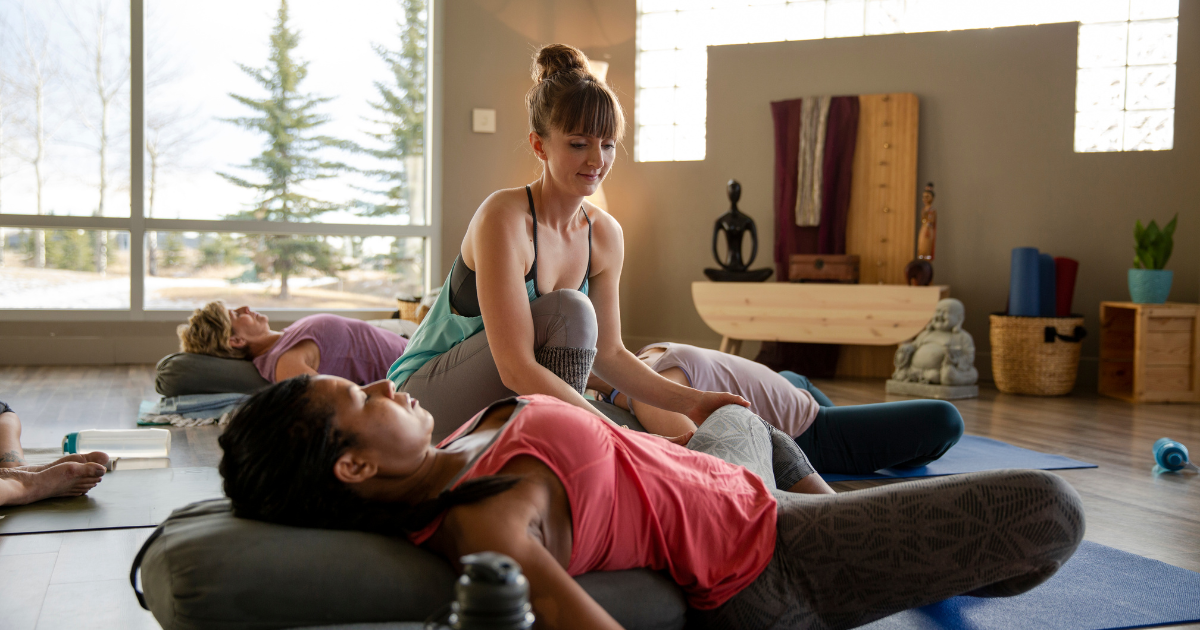
Restorative yoga can look deceptively simple. Students settle into supported poses, the lights are dimmed, and the room becomes quiet. But creating a restorative practice takes more than putting out a few bolsters and blankets. Each pose requires thoughtful setup, appropriate support, and enough time for students to settle in comfortably. As a teacher, your attention shifts from leading movement to observing the room and making small adjustments when needed.
And you don't need an entire studio of props to do it well. Here are four ways to approach restorative yoga with greater intention and flexibility.
1. Make support the foundation of every pose
In restorative yoga, props help support the body so students can spend less effort maintaining a position.
Pay attention to how students are settling into each pose. Are their shoulders relaxed? Are they holding tension in their jaw? Are their legs shifting because they haven't found a comfortable position?
Sometimes a small adjustment makes a meaningful difference. A folded blanket beneath the knees, additional support beneath the head, or a change in the angle of a bolster can help a student find a more comfortable position.
Give students time to settle before moving on. Check in, offer adjustments when appropriate, and remind them that they can change their position whenever they need to.
2. Learn to work with what you have
A studio filled with bolsters, blocks, and blankets offers plenty of possibilities, but restorative yoga doesn't depend on having professional equipment.
Think in terms of high-prop and low-prop options.
A high-prop variation of a supported reclined pose might use a bolster along the spine, blocks beneath the thighs, and a folded blanket under the head.
A low-prop variation might use a firm couch cushion, a rolled towel, and a wall for additional support.
Learning to teach both approaches gives you more flexibility as a teacher. It also makes it easier to share practices students can recreate at home or in spaces where traditional yoga equipment isn't available.
The important part isn't how many props you use. It's understanding what each prop contributes and how to arrange support for the individual student.
3. Choose fewer poses and give them more time
Restorative classes generally include fewer poses than a typical movement-based class. Rather than moving quickly from one shape to another, allow students several minutes to settle into each position.
Transitions deserve just as much attention as the poses themselves. Give clear, simple instructions before students begin moving, and allow enough time for them to reposition themselves without feeling rushed.
A well-planned class doesn't need a long list of poses to feel complete. Thoughtful sequencing, comfortable support, and unhurried transitions can create a cohesive experience.
4. Adapt the practice to the season and the students
The environment and the people in the room both influence how you plan a restorative class.
During colder months, you might offer additional blankets, warmer layers, and more fully supported reclined positions. In warmer weather, you might keep the room lighter and offer a different selection of supported shapes.
Just as importantly, consider the individual needs of your students.
Not everyone is comfortable lying flat on their back or getting down onto the floor. A seated position, an elevated torso, or additional support beneath the legs may offer a more appropriate starting point.
Give students options and encourage them to communicate what feels comfortable. Restorative teaching is less about getting everyone into the same pose and more about understanding how to make each position work for the person practicing it.
A practice to bring into your next class
Choose one restorative pose and plan two different setups: one using all the props available in your studio, and another using only a blanket and a wall.
Try teaching the low-prop version and invite students to explore how they might recreate the setup at home.
Then experience it yourself. Lie on your back with your legs resting against a wall, or place your lower legs on the seat of a chair. Add a folded blanket beneath your head if needed, and spend five minutes noticing how the different points of support feel.
Consider what you might adjust to make the position more comfortable.
Sometimes, learning to teach restorative yoga starts with learning how to receive support yourself.
Related reading from our sister school, NESBEM: What Changes When We Stop Being In Nature and Start Being With Her.
Interested In Learning More About Our Yoga Therapy Certification? Click here.

Getting Your RYT 300: Why a Modular Online Program Makes Advanced Yoga Training More Accessible

You have your 200-hour certification. You are teaching, your students trust you, and you are good at what you do. And you are starting to sense that there is a next level — not just more hours, but more depth, more range, and more specialized skills that would let you teach differently and serve your students more fully.
The RYT 500 is the obvious goal. But the path to it — a 300-hour advanced training — can feel daunting when you are already teaching a full schedule, and when most programs seem to require significant blocks of time, significant travel, or both.
This is exactly where a modular online program changes the equation. And understanding what to look for in one — and what skills you should expect to gain — makes all the difference between a credential that hangs on the wall and one that transforms your teaching.
“📌 What a Modular Program Actually Means
A modular yoga teacher training divides the 300 required hours into distinct, separately scheduled modules — each covering a specific area of study, each earning standalone credentials, and each completable without requiring the others to be done first or simultaneously. For a working yoga teacher, this means you can build your RYT 500 credential incrementally, at a pace that fits your teaching schedule, without sacrificing the depth or rigor of the training.”
What to Look for in a 300-Hour Online Program
Not all 300-hour programs are equally useful. The credential — Yoga Alliance RYT 500 — is the same regardless of the program. What differs is whether the skills you gain actually show up in your teaching, expand your studio offerings, and make you more effective with private clients.
The programs worth investing in share several qualities:
● Real content depth in each module: not just more advanced alignment, but genuinely new skill areas — therapeutic applications, specialty modalities, philosophical depth
● Skills that transfer immediately: you should be able to use what you learn in your next class or private session, not just in a future advanced setting
● Faculty with genuine expertise: each module taught by practitioners who specialize in that area, not generalists covering everything
● Live instruction: not purely self-paced video — real-time interaction with faculty and peers
● Credentials that compound: each module should produce standalone value: Yoga Alliance CEs, specialty certifications, or hours toward a further credential like IAYT yoga therapy certification
What PYI's Modular RYT 300 Covers — and Why It Matters
PYI's 300-hour advanced training is structured as three 100-hour modules, each a distinct area of specialty study. Together they total 300 hours toward your Yoga Alliance 300-Hour Certificate and RYT 500 designation. Each module also counts toward PYI's IAYT-Accredited Yoga Therapist Certification for students who continue on that path.
Module 1: Yoga in Healthcare
Evidence-based yoga for clinical and healthcare-adjacent settings. Covers Yoga Nidra, therapeutic breathwork and Heart Rate Variability, condition-specific yoga applications (chronic pain, PTSD, anxiety, cardiac health), and motivational coaching. Taught by Dr. Loren Fishman (MD, Columbia University) and Dr. Chris Walling (PsyD, C-IAYT). This module is not just about clinical career opportunities — the skills transfer directly into studio and private session work with any student managing a health condition, stress, or chronic pain.
Module 2: Therapeutic Essentials
The foundational clinical skill set of yoga therapy — including restorative yoga, slow flow, and the applied anatomy and physiology that underpin therapeutic teaching. This module builds the ability to work safely and effectively with students who have injuries, limitations, or chronic conditions — a skill set that is increasingly expected in any serious teaching environment, studio or otherwise. Includes Yoga Nidra and meditation as therapeutic tools.
Module 3: Ayurvedic and Vedic Yoga Therapy Training
One of the most distinctive and in-demand modules in the program — covering the classical Indian frameworks of Ayurveda and Vedic yoga philosophy as applied to modern therapeutic teaching. Includes dosha-based yoga prescriptions, Ayurvedic self-care practices, and the classical stories and philosophical frameworks behind the chants and mantras most yoga teachers use without fully understanding. This module is what separates a yoga teacher with a philosophical practice from one who teaches from a truly deep well.
“🌿 Skills That Show Up in the Studio Immediately
Every module in PYI’s 300-hour program produces skills you can use Monday morning: Yoga Nidra sequences for restorative classes, breathwork protocols for anxious students, Ayurvedic themes for class design, therapeutic modifications for injured practitioners. This is not abstract advanced study. It is directly applicable expertise that makes you a more versatile, more effective, and more sought-after teacher.”
Online and Live — What That Actually Looks Like
PYI's program is fully online with live faculty sessions — meaning you are not watching recorded videos in isolation but attending real-time classes with instructors and cohort peers. For the Yoga in Healthcare module, there is also an optional in-person session in New York City for those who want that experience.
This format works for working teachers because the scheduling is designed around a teaching life: evening and weekend sessions that do not require you to stop teaching to study. The community built in live online cohorts is also genuinely meaningful — many PYI students describe the relationships built in the program as one of its most lasting benefits.
🏅 PYI's IAYT-Accredited Yoga Therapy Certification
• 100 hours toward your Yoga Alliance 300-Hour Certificate (RYT 500 track) • 100 hours toward PYI's IAYT-Accredited Yoga Therapist Certification (additional prerequisites apply) • Yoga Alliance Continuing Education Credits (CEs) Course dates: October 2 – November 14, 2026. Live online with optional in-person NYC session.
“→ Build Your RYT 500 on a Schedule That Works
PYI’s modular online 300-hour advanced yoga teacher training covers Yoga Nidra, yoga in healthcare, restorative yoga, Ayurvedic yoga therapy, and more — in a format designed for working teachers. Each module counts toward your Yoga Alliance 300-Hour Certificate and PYI’s IAYT-Accredited Yoga Therapist Certification. Learn more at Prema Yoga Institute.”