

The Key Instruments of Sound Yoga Therapy: A Guide for Yoga Teachers and Wellness Professionals

If you've ever been in a room when a Himalayan singing bowl rings out and felt something in your chest release before you could even name what was held there, you already have a felt sense of what sound yoga therapy does. You've experienced the instrument working.
But sound yoga therapy is not a single instrument or a single technique. It is a rich family of tools — each with its own voice, its own therapeutic application, and its own tradition — that a skilled practitioner learns to choose from and combine with intention.
For yoga teachers and wellness professionals beginning to explore this field, one of the most grounding starting points is simply understanding what the instruments are: where they come from, how they work physiologically, and what each one is uniquely suited to do. That orientation is what this blog offers.
PYI's introductory Sound Yoga Therapy Training provides hands-on experience with many of these instruments. This guide will help you arrive at that training — or begin exploring on your own — with a clear sense of the landscape.
“🎵 A Note on Scope
Sound yoga therapy draws from a wide world of instruments — more than any introductory training can cover in full depth. PYI’s weekend training introduces the core instruments most relevant to yoga teachers and yoga therapists: the human voice, Himalayan singing bowls, tuning forks, Koshi chimes, Tingshas, harmonium, and shruti box. Deeper study with individual instruments — including the gong, crystal bowls, and frame drum — is a natural next step for those who feel drawn to specialize.”
The Human Voice: Your First and Most Essential Instrument
Before any physical instrument enters the room, you already have the most versatile sound healing tool available: your voice. This is not a poetic statement — it is anatomical fact, and it is where PYI's sound yoga therapy training begins.
The voice produces sound from inside the body. When you tone, hum, or chant, the vibration resonates not just outward into the room but inward through the body itself — through bone, tissue, and the fluid-filled chambers of the skull. This is the principle of bone conduction, identified by French physician Dr. Alfred Tomatis, and it is why vocal sound produces effects that external instruments, however beautiful, cannot fully replicate.
For yoga teachers, the voice is also the most immediately practical starting point. You carry it to every class, it requires no investment, and — used with even basic knowledge of toning and mantra — it begins changing the quality of your students' experience right away.
“📌 A Simple Bīja Integration: Three Steps
Step 1: Choose one bīja that matches your class theme (e.g., YAM for a heart-focused class). Step 2: Briefly explain what it is — one sentence: “YAM is the seed sound of the heart chakra — repeating it helps us tune into that center’s energy.” Step 3: Offer 3–5 rounds in a comfortable seated position, eyes closed, after the peak of the practice. That’s a complete, credible, immediately effective sound integration. No instruments required.”
The Human Voice: Your First and Most Essential Instrument
Before any physical instrument enters the room, you already have the most versatile sound healing tool available: your voice. This is not a poetic statement — it is anatomical fact, and it is where PYI's sound yoga therapy training begins.
The voice produces sound from inside the body. When you tone, hum, or chant, the vibration resonates not just outward into the room but inward through the body itself — through bone, tissue, and the fluid-filled chambers of the skull. This is the principle of bone conduction, identified by French physician Dr. Alfred Tomatis, and it is why vocal sound produces effects that external instruments, however beautiful, cannot fully replicate.
For yoga teachers, the voice is also the most immediately practical starting point. You carry it to every class, it requires no investment, and — used with even basic knowledge of toning and mantra — it begins changing the quality of your students' experience right away.
Toning
Toning is the practice of sustaining a single open vowel sound on a long, slow exhale. Different vowel shapes — "ahhh," "ohhh," "mmm" — resonate in different parts of the body and produce different physiological effects. Humming alone, as research consistently shows, increases nasal nitric oxide production by 15 to 20 times, triggering a measurable shift into parasympathetic mode.
Mantra and Bīja Syllables
Mantra — sacred sound formulas drawn from the Vedic and Tantric traditions — and bījas (seed syllables associated with each chakra) are among the most ancient and precisely developed sound healing tools in the yogic lineage. Each carries not just a sound but a story, an intention, and a lineage of use. In PYI's training, students learn not only how to use these sounds but where they come from — the classical myths and teachings that give them depth and meaning.
Himalayan Singing Bowls: The Heart of the Sound Bath
When most people picture sound healing, they are picturing a Himalayan singing bowl. Also called Tibetan singing bowls — though their origin spans the Himalayan regions of Nepal, Tibet, India, and Bhutan — these hand-hammered metal bowls are among the most widely used instruments in contemporary sound yoga therapy, and for good reason.
Himalayan bowls are what are known as multi-tonal instruments: a single bowl produces not one note but a rich cluster of overtones — harmonics that layer and interact as the sound sustains and evolves. This complex, living tone is one of the reasons the bowls produce such a distinctive effect in the body. The nervous system has no single frequency to habituate to; instead it is held in a state of alert relaxation, receiving.
How They Are Played
Himalayan bowls can be struck with a padded mallet to produce a clear initial tone that then rings out and slowly decays. They can also be played by circling the rim with a wooden or suede-wrapped striker — the same principle as running a wet finger around the edge of a crystal goblet — to sustain a continuous, evolving tone. Each technique produces a different quality of sound and a different effect in the listener.
Therapeutic Applications
Group classes: a single bowl struck at the opening of Savasana creates an immediate, collective shift into rest. Multiple bowls played together build an immersive sonic environment for a full sound bath
Private yoga therapy sessions: bowls can be placed on or near the body, allowing the client to feel the vibration directly as well as hear it — particularly effective for releasing held tension in specific areas
Transitions: a single clear tone used between poses or sequences serves as a sonic anchor, bringing scattered attention back to the present moment
“📌 Choosing Your First Bowl
For yoga teachers beginning their sound healing journey, one quality Himalayan bowl is enough to start. Look for a hand-hammered bowl (not machine-made) in a medium size — approximately 5 to 7 inches — which produces a tone that is warm and accessible without being overwhelming. Play it before you buy it if possible: your body’s response to the sound is the most reliable guide.”
Tuning Forks: Precision Tools for Yoga Therapists
Where Himalayan bowls work broadly — filling a room, washing over a group, creating a collective field of resonance — tuning forks work precisely. They are calibrated metal instruments, each designed to vibrate at a specific frequency, and they are among the most clinically sophisticated tools in the sound yoga therapy toolkit.
For this reason, tuning forks are particularly valuable for yoga therapists working one-on-one with clients, and are introduced in PYI's training as instruments for individual therapeutic application rather than group settings.
How They Work
A tuning fork is struck against a padded surface or the heel of the hand, setting it vibrating at its calibrated frequency. It can then be held near the body — in the biofield, the subtle energy field understood in both Ayurvedic and Chinese medicine traditions to surround physical form — or placed directly on the body at specific therapeutic points. The vibration is felt as well as heard, and the effect is immediate.
Sound researcher and naturopath John Beaulieu, PhD, describes the therapeutic mechanism as inducing a "still point" — a brief moment of suspension in which the nervous system has the opportunity to reset a habitual pattern of tension, stress, or pain. This still point is not metaphorical. It corresponds to a measurable node in the vibration where amplitude briefly reaches zero, and the nervous system, entrained to the fork's frequency, enters that same pause.
Common Therapeutic Frequencies
128 Hz: used for deep tissue and bone work; associated with nitric oxide release and circulatory support
136.10 Hz (the Om frequency): corresponds to the Earth's orbital frequency; used for grounding and centering
528 Hz: sometimes called the "transformation tone"; associated with calming and emotional regulation
For yoga therapists working with clients experiencing chronic pain, anxiety, post-surgical recovery, or trauma-related holding patterns, tuning forks offer a gentle, precise, and non-invasive point of intervention that complements asana and pranayama beautifully.
Koshi Chimes: The Gentlest Entry Point
If Himalayan bowls are the heart of the sound bath and tuning forks are the precision instruments of the yoga therapist, Koshi chimes are the instrument that asks almost nothing of the teacher and delivers an immediate, beautiful effect with every use.
Koshi chimes are small, hand-crafted cylindrical instruments, each tuned to one of the four classical elements: Earth, Water, Fire, and Air. When rotated, the metal rods inside strike the outer cylinder in cascading patterns, producing a gentle, luminous tone that is nearly impossible to play incorrectly and deeply pleasant to receive.
For yoga teachers new to sound, Koshi chimes are often the first instrument that feels completely natural in a class setting. There is no technique to master, no learning curve to manage. You rotate the chime, and the sound does its work.
How to Use Them in Class
Savasana opening or close: a few gentle rotations as students settle into final rest, or as a soft signal that class is complete
Transition between sections: the delicate, fading tone creates a natural pause between sequences without requiring the teacher to speak
Meditation anchor: the Earth or Water chime played at the beginning of a seated meditation gives the mind a point of focus to return to
Tingshas: Space Clearing and the Sound of Arrival
Tingshas are small paired cymbals, traditionally Tibetan, connected by a leather or silk cord. When struck together, they produce a clear, bright, piercing tone that rings out and sustains with remarkable clarity. That tone — present, sharp, and unmistakable — is their function.
In traditional Tibetan Buddhist practice, Tingshas are used to clear energetic space before ceremony or meditation. In contemporary sound yoga therapy and yoga teaching, they serve a similar purpose: they mark a clear beginning, call scattered attention back to center, and signal transitions with a precision that a verbal cue cannot match.
How to Use Them in Class
Opening a class or meditation: three strikes of the Tingshas before you begin speaking creates immediate presence and quiet
Closing Savasana: the clear tone calls students gently back from deep rest without the jolt of a verbal cue
Space clearing: used before class to energetically prepare the room — a practice rooted in Tibetan tradition that many teachers find settles both the space and their own pre-class energy
“💬 What Students Are Saying
’Game changer. This course helped me truly find my voice and incorporate sound aspects into my live yoga classes — and eventually into my one-on-one yoga therapy sessions. I’m eternally grateful for what this course added to my life and my career.’ — Ann, PYI Sound Yoga Therapy Training Graduate ‘This training was by far my favorite training of the yoga therapy curriculum. I had no idea how deeply I needed to find my true voice until Jessica and Dana guided me in vocal work. — Stephanie, PYI Sound Yoga Therapy Training Graduate One of my favorite trainings. This work is incredibly powerful and healing.’ — Angela, PYI Sound Yoga Therapy Training Graduate”
Harmonium and Shruti Box: The Foundation of the Drone
In the Indian classical music and devotional traditions that gave birth to Nada Yoga, almost no chanting happens without a drone — a sustained, continuous tone that anchors the voice and the room in a shared pitch center. The harmonium and the shruti box are the two most common instruments used to create that foundation, and both have found a natural home in contemporary sound yoga therapy and kirtan-based teaching.
The Harmonium
The harmonium is a small hand-pumped reed organ, introduced to India during the colonial era and so thoroughly absorbed into Indian devotional music that it is now inseparable from it. In bhakti yoga practice and kirtan, the harmonium is the instrument that leads and sustains the chant — the teacher or musician plays the melody while pumping the bellows with one hand, and the sound fills the room with a warm, rich resonance that invites the voice to settle and open.
For yoga teachers who lead group chanting, mantra circles, or kirtan-inspired classes, the harmonium is a transformative addition to the teaching toolkit. It does not require prior musical training to begin — many teachers start simply by finding the drone note and holding it while students chant — and its learning curve, while real, is genuinely accessible.
Therapeutically, the sustained drone created by the harmonium serves as an entrainment anchor: the voice naturally wants to align with it, and that alignment produces a felt sense of resonance and belonging in the body that is one of the most direct experiences of what sound yoga therapy is designed to offer.
The Shruti Box
The shruti box is the harmonium's quieter, simpler sibling. Where the harmonium is a melodic instrument capable of playing full chords and moving lines, the shruti box is a single-purpose drone machine — a small bellows-driven box that sustains one or several pitches continuously while you chant, tone, or guide a class through vocal practice.
For yoga teachers and yoga therapists who are not ready to invest the time in learning the harmonium, the shruti box is an ideal bridge. It is inexpensive, compact, requires no musical skill beyond selecting a pitch, and provides the same essential function: a continuous tonal foundation that supports and enriches the voice.
In a private yoga therapy session, a softly humming shruti box in the background can profoundly deepen the quality of guided pranayama, mantra repetition, or restorative practice — giving the client's nervous system a constant, gentle sonic anchor throughout the session.
Why the Drone Matters
Both instruments point toward the same therapeutic principle: the human voice and nervous system are deeply responsive to sustained tonal stability. When there is a drone in the room, the body relaxes its search for solid ground. The chattering mind has something to rest against. Students who resist chanting or feel self-conscious about their voices often find that the drone makes it feel safe — even effortless — to open and sound.
In the vocabulary of sound yoga therapy, this is entrainment working at its most natural and human: voice meeting tone, and both finding their way home.
The Gong: Powerful, Immersive, and Not for Beginners
No instrument in the sound healing world commands a room quite like the gong. Its deep, complex, continuously evolving sound — produced by a large metal disc struck with a padded mallet and then guided by the player's hands — creates what many practitioners describe as the most immersive sonic experience available in therapeutic sound work.
The gong produces an extraordinarily wide range of frequencies simultaneously, from sub-bass vibrations felt in the chest and abdomen to high overtones that seem to come from everywhere at once. This full-spectrum quality is both its greatest therapeutic asset and the reason it requires significant training and sensitivity to use well.
The gong is not covered in PYI's introductory Sound Yoga Therapy Training — it is the kind of instrument that rewards dedicated, focused study over time. However, understanding it as part of the broader landscape of sound healing helps orient the new practitioner toward where their path might eventually lead.
Why It Matters for Yoga Therapists
For yoga therapists working with deeply held tension, trauma, or chronic stress patterns, the gong's full-spectrum vibration can reach layers of the nervous system that more subtle instruments cannot access. Experienced gong practitioners describe working with the instrument as a form of active listening — the player responds to the room, the participants, and the sound itself in real time, navigating a dynamic and powerful therapeutic field.
If the gong calls to you, PYI's introductory training is an excellent foundation from which to pursue that deeper study.
Which Instruments Are Right for You?
The honest answer is that this is something you discover through direct experience — which is precisely what PYI's introductory Sound Yoga Therapy Training is designed to offer. Before you invest in instruments or commit to a specialization, you need to actually play them, hear them in a room, and notice which ones your body and your students respond to most deeply.
That said, a few practical guidelines:
If you teach group yoga classes: start with one Himalayan bowl and a set of Tingshas. These two instruments alone will transform your Savasana and your class openings
If you work one-on-one with yoga therapy clients: add a set of therapeutic tuning forks. The precision they offer for individual work is unmatched by any group instrument
If you want something gentle and immediately accessible: Koshi chimes require no technique and produce an immediate, beautiful effect in any setting
If you are drawn to deeper study: let PYI's introductory training show you which instruments resonate most for you, then pursue advanced study in those specifically
“→ Explore These Instruments in PYI’s Introductory Sound Yoga Therapy Training
PYI’s introductory Sound Yoga Therapy Training gives yoga teachers and wellness professionals hands-on, introductory experience with the core instruments of therapeutic sound — the voice, Himalayan bowls, tuning forks, Koshi chimes, Tingshas, harmonium, and shruti box — alongside the science and tradition that make them work. Live online nationwide. Students also have the option of joining in person in the Hudson Valley for one Sunday in 2026. Earns Yoga Alliance CEUs and IAYT APD hours. No musical experience required.”
Interested in deepening your knowledge of sound work in an introductory course inspired by the yoga tradition? Check out our annual Sound Yoga Training here.

How to Incorporate Sound Into Your Yoga Teaching: A Practical Guide for RYT 200 and RYT 500 Teachers
You've felt it. A student finally lets go in Savasana — not because the sequence was perfect, but because you hummed a single sustained note and something in the room changed. Or you ended class with three rounds of So hum and watched shoulders drop two inches in ten seconds.
Sound does something in a yoga class that asana alone cannot do. It reaches the nervous system through a different door. And once you experience it working — really working — you want to know how to use it intentionally, skillfully, and consistently.
The good news: you don't need a room full of instruments, a music degree, or a complete overhaul of your teaching style to begin. You can start today, in your next class, with nothing more than your breath and your voice. And you can build from there at whatever pace suits you.
This guide is for yoga teachers at every level — whether you're newly certified at RYT 200 and curious, or an experienced RYT 500 looking to deepen your therapeutic offerings. It walks you through exactly how to start incorporating sound into your yoga teaching, from the simplest possible entry points to more advanced tools.
“🎵 Why Sound Works So Quickly
Sound bypasses the analytical mind and speaks directly to the nervous system. While a well-cued alignment instruction requires the brain to process language, decode meaning, and translate it into physical action, sound entrains the body immediately — organizing neural activity, stimulating the vagus nerve, and shifting brainwave states in real time. This is why a single singing bowl tone can do in ten seconds what ten minutes of cueing sometimes cannot.”
Start Where You Already Are: Your Voice
The most common mistake yoga teachers make when they want to incorporate sound is thinking they need instruments before they can begin. They don't. Your voice is already a precision sound healing instrument — and you have been using it in every class you have ever taught.
The shift is not about doing something new. It is about doing what you already do with more intention.
Humming at the Start of Class
Before you begin cueing — before you say a single word — invite your students to close their eyes, take a natural breath, and exhale with a sustained "mmm" sound. Lips gently closed, jaw relaxed, no specific pitch. Just vibration.
Three rounds. That's it.
What is actually happening: humming increases nasal nitric oxide production by 15 to 20 times, signaling the body to shift into parasympathetic mode. Your students' nervous systems are literally beginning to downregulate before you've cued a single pose. You've set the tone — in every sense of the word — for the entire class.
Toning Through Transitions
As students move through transitions — particularly into or out of longer held poses — guide them to exhale with an open vowel sound rather than a silent breath. A long, open "ahhh" on the exhale out of a deep forward fold. A soft "ohm" as they rise from the floor.
This is toning: the practice of creating sustained, intentional vocal sound that resonates through the body rather than simply passing through it. It deepens the breath, releases held tension in the jaw and throat, and gives the nervous system a signal that it is safe to let go.
Many students feel self-conscious at first. That self-consciousness is itself useful information — it often points to exactly where they are holding. Be patient, be consistent, and let your own voice lead without apology.
Closing with So Hum
The mantra So hum — "I am that" — is one of the most universally accessible sound practices in the yogic tradition. Coordinated with the breath (silent So on the inhale, audible hum on the exhale), it settles the mind and draws attention inward with a gentleness that most verbal instructions cannot match.
Three to five rounds at the close of class — before Savasana or before final seated meditation — creates a consistent ritual that students begin to anticipate and depend on. Over time, the sound itself becomes a conditioned cue for deep rest.
Adding Bīja Syllables: One at a Time
Once your students are comfortable with simple toning and So hum, bīja syllables — the seed sounds associated with each chakra — are a natural next step. These single-syllable sounds (LAM, VAM, RAM, YAM, HAM, AUM, and silence for the crown) have been used for thousands of years in the Nada Yoga tradition to balance the energetic body.
The key word for incorporating them into yoga teaching is: one at a time.
Rather than introducing all seven chakra bījas in a single class, choose one that aligns with your class theme and offer it in one specific moment. Teaching a grounding sequence? Offer LAM (root chakra) in a seated meditation at the close. Building a heart-opening class? Invite YAM during a long hold in a chest-opening pose.
This approach keeps students from feeling overwhelmed, creates thematic coherence in your class design, and gives the bīja space to actually land and resonate rather than becoming a list to memorize.
“📌 A Simple Bīja Integration: Three Steps
Step 1: Choose one bīja that matches your class theme (e.g., YAM for a heart-focused class). Step 2: Briefly explain what it is — one sentence: “YAM is the seed sound of the heart chakra — repeating it helps us tune into that center’s energy.” Step 3: Offer 3–5 rounds in a comfortable seated position, eyes closed, after the peak of the practice. That’s a complete, credible, immediately effective sound integration. No instruments required.”
Introducing Instruments: Where to Start
When you are ready to bring physical instruments into your teaching, the learning curve is shorter than most teachers expect — especially if you've already established a sound practice using your voice. Your students' nervous systems are already attuned to the idea of sound as part of the practice. The instruments deepen that; they don't introduce it from scratch.
Start With a Single Himalayan Singing Bowl
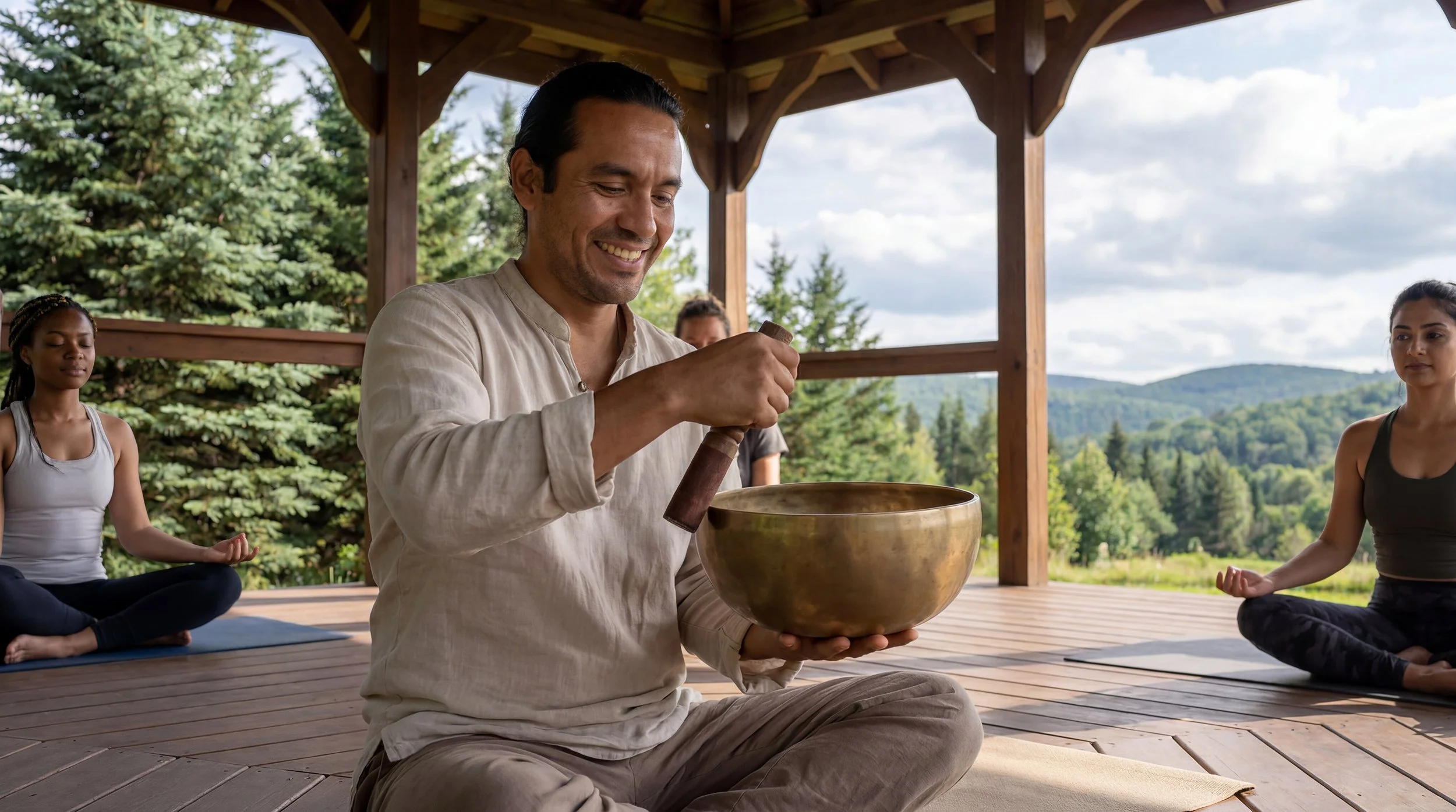
A single, quality Himalayan singing bowl is the most versatile entry point into instrument-based sound work for yoga teachers. It requires no musical knowledge to use effectively, it travels easily, and its overtone-rich tone produces an immediate, full-body response in most students.
The simplest application: strike the bowl once at the beginning of Savasana and let the tone ring out completely before you begin guiding the relaxation. Let the silence that follows the tone do the work. Students will settle into it naturally.
Tuning Forks for Private Sessions and Yoga Therapy
For yoga teachers who work with private clients or are on the path to yoga therapy certification, tuning forks offer a level of precision that group instruments cannot. Small, portable, and calibrated to specific therapeutic frequencies, tuning forks can be used directly on or near the body to induce a "still point" — a momentary suspension in which the nervous system has the opportunity to reset.
They are particularly valuable for working with students experiencing chronic tension, trauma-related holding patterns, or anxiety — populations that yoga therapists and advanced yoga teachers frequently encounter.
Koshi Chimes for Group Classes
If you want a sound element that requires even less technique than a singing bowl, Koshi chimes are an excellent option for group settings. Their gentle, cascading tones carry beautifully in a yoga space without overwhelming it. Many teachers use them at the very end of class as a quiet sonic closing — a few gentle chimes as students rest in Savasana. It takes ten seconds and leaves a lasting impression.
Designing a Class That Builds With Sound
Once you have individual tools in your toolkit, the next level is thinking about sound as an arc that runs through the entire class — not just a moment added at the beginning or end. A sound-integrated yoga class might move through these layers:
Opening: three rounds of humming or a grounding bīja to transition students from their day into the practice
During dynamic sequences: encourage audible exhales and open-vowel toning through effort — this regulates the nervous system during exertion and keeps students connected to breath
In long-held poses: offer a relevant bīja or invite students into silent internal toning, feeling the vibration in the area of the body being worked
At the peak of practice: a single, clear bowl tone to mark the transition toward cooling down — a sonic signal that the work of the body is done
In Savasana: sustained bowl playing or chimes, calibrated to the energy of the room
Closing: So hum or AUM to seal the practice and bring individual awareness back into collective resonance
This kind of intentional sound architecture doesn't require more class time — it uses the time you already have more skillfully. Most students won't consciously register how much sound is in the class. They'll just know they feel more deeply arrived at the end of it.
“🌿 Sound and Yoga Therapy: A Natural Partnership
For yoga teachers pursuing yoga therapy certification, sound integration is not just a teaching enhancement — it is a clinical skill. Therapeutic sound addresses the nervous system, the energetic body, and the emotional landscape in ways that movement alone cannot always reach. Students with chronic pain, trauma histories, anxiety disorders, and autoimmune conditions often respond to sound-based interventions with a speed and depth that surprises even experienced clinicians. PYI’s Sound Yoga training prepares yoga teachers and yoga therapists to use these tools with confidence and precision.”
The Most Important Thing: Start Before You Feel Ready
Every yoga teacher who now leads sound-rich classes will tell you the same thing: they started before they felt ready. They introduced So hum when they still felt a little self-conscious about it. They brought a singing bowl to class before they felt like they "knew enough."
Sound is not a subject you master and then teach. It is something you practice — alongside your students — and deepen over time.
What a Sound Yoga training gives you is the foundation to start confidently: the science to understand what you're doing, the tradition to know where it comes from, and the practical technique to do it well from the beginning. PYI's weekend Sound Yoga training compresses years of trial-and-error into a single focused weekend — so you leave with tools you can use on Monday morning.
Whether you are completing your RYT 200 and looking to differentiate your teaching from the start, building toward your RYT 500 with a therapeutic focus, or deepening your practice toward IAYT yoga therapy certification — sound belongs in your toolkit.
The training is available live online nationwide, with a Saturday in-person intensive in the Hudson Valley in 2026. It earns Yoga Alliance continuing education hours (CEUs), IAYT Applied Professional Development (APD) hours, and 25 credit hours toward PYI's full yoga therapy certification program.
“→ Ready to Bring Sound Into Your Teaching? Start This Weekend.
PYI’s Sound Yoga training gives yoga teachers the science, tradition, and hands-on technique to incorporate sound confidently and immediately. One weekend. Live online nationwide — plus a Saturday in-person intensive in the Hudson Valley in 2026. Yoga Alliance CEUs, IAYT APD hours, and 25 credit hours toward yoga therapy certification. No musical experience required. Enroll now.”
Interested in deepening your knowledge of sound work in an introductory course inspired by the yoga tradition? Check out our annual Sound Yoga Training here.

Toning, Tuning Forks, and the Healing Voice: What Every Yoga Teacher and Wellness Professional Should Know About Sound Therapy

Most yoga teachers think of sound healing as something that requires a room full of expensive instruments, years of musical training, and a particular kind of otherworldly personality.
None of that is true.
The most powerful sound healing tool you have is already with you. You were born with it. You use it every time you cue a class, guide a meditation, or simply say "breathe." It is your voice — and when used with knowledge and intention, it is one of the most therapeutically effective instruments that exists.
Add a set of tuning forks — one of the most portable, precise, and scientifically grounded sound healing tools available — and you have a complete sound therapy toolkit that fits in a small bag and can be used in any yoga class, private session, or wellness appointment.
Here's the science and practice behind both.
The Healing Power of Toning: Your Voice as an Instrument
Toning is the practice of creating sustained, intentional vocal sound — not singing, not speaking, but a middle space where the voice becomes a vibrational tool. You don't need to be able to carry a tune. You don't need any prior vocal training. What you need is breath and willingness.
The effects of toning on the body and nervous system are measurable, well-documented, and sometimes startling in how quickly they work.
Nitric Oxide: The Hidden Mechanism
One of the most remarkable findings in sound healing research is this: the simple act of humming increases nasal nitric oxide (NO) production by 15 to 20 times. Nitric oxide is a gas molecule that signals the body to shift into parasympathetic mode — the rest-and-digest state that is the physiological opposite of the stress response.
When nitric oxide increases, vascular flow improves, immune function strengthens, mental clarity sharpens, and the nervous system begins to regulate. All from humming. No instruments required.
For yoga teachers, this means that even the simplest toning practice — three minutes of humming at the end of a class — is producing a genuine physiological shift in your students. This is not ambient wellness. It is applied physiology.
Bone Conduction: Sound Goes Deeper Than You Think
Dr. Alfred Tomatis, the pioneering French physician who spent decades studying the relationship between sound and the nervous system, discovered that human beings hear not just through our ears but through bone conduction — the direct transmission of sound vibration through the skeletal structure.
When you tone or chant, the sound reverberates through the bony cavities of your skull, sternum, and chest. This vibration directly stimulates the vestibular system in the inner ear — the system that governs balance, posture, and proprioception. Toning with pursed lips is particularly effective at activating this system.
Practically speaking: this is why toning feels so different from listening. It is a full-body experience, not just an auditory one. And it is why teaching your students to tone — even briefly, even with resistance — produces effects that music alone cannot replicate.
“🎵 A Simple Toning Practice You Can Use in Class Today
Guide students into a comfortable seated or supine position. Invite them to inhale naturally, then exhale through a sustained “mmm” sound — lips gently closed, jaw relaxed. No specific pitch. No performance. Just vibration. Three rounds. Notice what changes. This alone increases nitric oxide, activates the vagus nerve, and begins to shift the nervous system toward parasympathetic dominance. It takes four minutes. It works every time.”
Tuning Forks: Finding the Still Point
If the voice is your most accessible sound healing instrument, tuning forks are your most precise. Small, portable, inexpensive, and grounded in well-understood physics, tuning forks have been used therapeutically for over a century — and are increasingly integrated into yoga therapy, somatic practice, and integrative health.
Sound researcher and naturopath John Beaulieu, PhD, has devoted decades to studying the therapeutic application of tuning forks. His key insight: tuning forks are calibrated to induce what he calls a "still point" — a brief moment of energetic suspension in which the nervous system has the opportunity to reset.
What Is a Still Point?
In acoustics, a still point is a node — a location where the amplitude of a vibration is zero. Between the waves of sound, there is momentary stillness. Beaulieu found that when the nervous system is exposed to the archetypal tones produced by calibrated tuning forks, it naturally gravitates toward this still point — and that entering it creates the conditions for releasing chronic tension patterns, resetting habitual stress responses, and allowing new neural pathways to form.
In his words: when we hear the tones of the forks, "we are drawn into a still point, and our nervous system naturally shifts into a new tone."
For yoga teachers and yoga therapists working with students who are stuck — in chronic pain, in trauma patterns, in the exhausting loop of a hyperactivated stress response — tuning forks offer a gentle, non-invasive, and genuinely effective point of intervention.
Entrainment: The Physics of Why It Works
The mechanism behind tuning fork therapy is the same principle that underlies all therapeutic sound work: entrainment. The brain's dominant frequency shifts toward the frequency of a dominant external stimulus. When a calibrated tuning fork is introduced near the body, the nervous system begins to synchronize with that frequency.
This is not metaphor. It is measurable in brainwave activity, heart rate variability, and galvanic skin response. The formula, as PYI's Sound Yoga curriculum frames it, is straightforward: Frequency + Intention = Healing.
Learning These Tools in PYI's Sound Yoga Training
PYI's weekend Sound Yoga training teaches both toning and tuning fork technique as practical, applicable skills — not abstract concepts. By the end of the training, yoga teachers and wellness professionals leave knowing:
How to guide students through toning exercises: with clear language, appropriate pacing, and sensitivity to different comfort levels
The specific toning shapes: (vowel sounds and syllables) that produce different physical, mental, and energetic effects
How to select and use tuning forks: including which forks to invest in first and how to position them for maximum effect
How to integrate both tools: into yoga classes, private sessions, and sound bath experiences
The science behind what you're doing: so you can explain it confidently to students, healthcare providers, and wellness colleagues
The training is available live online nationwide, with a Saturday in-person intensive in the Hudson Valley in 2026 — giving practitioners the option to work hands-on with instruments in a group setting. Either way, it earns Yoga Alliance CEUs, IAYT Applied Professional Development (APD) hours, and 25 credit hours toward PYI's full yoga therapy certification program — making it one of the highest-value weekend trainings available to yoga teachers and wellness professionals.
“→ Learn Toning, Tuning Forks, and Sound Healing in One Weekend
PYI’s Sound Yoga training is open to yoga teachers, wellness professionals, and all curious practitioners. No musical experience required. Earn Yoga Alliance CEUs, IAYT APD hours, and 25 credit hours toward yoga therapy certification. Live online nationwide — plus a Saturday in-person intensive in the Hudson Valley in 2026. Enrolling now.”
Interested in deepening your knowledge of sound work in an introductory course inspired by the yoga tradition? Check out our annual Sound Yoga Training here.