
How to Incorporate Sound Into Your Yoga Teaching: A Practical Guide for RYT 200 and RYT 500 Teachers
You've felt it. A student finally lets go in Savasana — not because the sequence was perfect, but because you hummed a single sustained note and something in the room changed. Or you ended class with three rounds of So hum and watched shoulders drop two inches in ten seconds.
Sound does something in a yoga class that asana alone cannot do. It reaches the nervous system through a different door. And once you experience it working — really working — you want to know how to use it intentionally, skillfully, and consistently.
The good news: you don't need a room full of instruments, a music degree, or a complete overhaul of your teaching style to begin. You can start today, in your next class, with nothing more than your breath and your voice. And you can build from there at whatever pace suits you.
This guide is for yoga teachers at every level — whether you're newly certified at RYT 200 and curious, or an experienced RYT 500 looking to deepen your therapeutic offerings. It walks you through exactly how to start incorporating sound into your yoga teaching, from the simplest possible entry points to more advanced tools.
“🎵 Why Sound Works So Quickly
Sound bypasses the analytical mind and speaks directly to the nervous system. While a well-cued alignment instruction requires the brain to process language, decode meaning, and translate it into physical action, sound entrains the body immediately — organizing neural activity, stimulating the vagus nerve, and shifting brainwave states in real time. This is why a single singing bowl tone can do in ten seconds what ten minutes of cueing sometimes cannot.”
Start Where You Already Are: Your Voice
The most common mistake yoga teachers make when they want to incorporate sound is thinking they need instruments before they can begin. They don't. Your voice is already a precision sound healing instrument — and you have been using it in every class you have ever taught.
The shift is not about doing something new. It is about doing what you already do with more intention.
Humming at the Start of Class
Before you begin cueing — before you say a single word — invite your students to close their eyes, take a natural breath, and exhale with a sustained "mmm" sound. Lips gently closed, jaw relaxed, no specific pitch. Just vibration.
Three rounds. That's it.
What is actually happening: humming increases nasal nitric oxide production by 15 to 20 times, signaling the body to shift into parasympathetic mode. Your students' nervous systems are literally beginning to downregulate before you've cued a single pose. You've set the tone — in every sense of the word — for the entire class.
Toning Through Transitions
As students move through transitions — particularly into or out of longer held poses — guide them to exhale with an open vowel sound rather than a silent breath. A long, open "ahhh" on the exhale out of a deep forward fold. A soft "ohm" as they rise from the floor.
This is toning: the practice of creating sustained, intentional vocal sound that resonates through the body rather than simply passing through it. It deepens the breath, releases held tension in the jaw and throat, and gives the nervous system a signal that it is safe to let go.
Many students feel self-conscious at first. That self-consciousness is itself useful information — it often points to exactly where they are holding. Be patient, be consistent, and let your own voice lead without apology.
Closing with So Hum
The mantra So hum — "I am that" — is one of the most universally accessible sound practices in the yogic tradition. Coordinated with the breath (silent So on the inhale, audible hum on the exhale), it settles the mind and draws attention inward with a gentleness that most verbal instructions cannot match.
Three to five rounds at the close of class — before Savasana or before final seated meditation — creates a consistent ritual that students begin to anticipate and depend on. Over time, the sound itself becomes a conditioned cue for deep rest.
Adding Bīja Syllables: One at a Time
Once your students are comfortable with simple toning and So hum, bīja syllables — the seed sounds associated with each chakra — are a natural next step. These single-syllable sounds (LAM, VAM, RAM, YAM, HAM, AUM, and silence for the crown) have been used for thousands of years in the Nada Yoga tradition to balance the energetic body.
The key word for incorporating them into yoga teaching is: one at a time.
Rather than introducing all seven chakra bījas in a single class, choose one that aligns with your class theme and offer it in one specific moment. Teaching a grounding sequence? Offer LAM (root chakra) in a seated meditation at the close. Building a heart-opening class? Invite YAM during a long hold in a chest-opening pose.
This approach keeps students from feeling overwhelmed, creates thematic coherence in your class design, and gives the bīja space to actually land and resonate rather than becoming a list to memorize.
“📌 A Simple Bīja Integration: Three Steps
Step 1: Choose one bīja that matches your class theme (e.g., YAM for a heart-focused class). Step 2: Briefly explain what it is — one sentence: “YAM is the seed sound of the heart chakra — repeating it helps us tune into that center’s energy.” Step 3: Offer 3–5 rounds in a comfortable seated position, eyes closed, after the peak of the practice. That’s a complete, credible, immediately effective sound integration. No instruments required.”
Introducing Instruments: Where to Start
When you are ready to bring physical instruments into your teaching, the learning curve is shorter than most teachers expect — especially if you've already established a sound practice using your voice. Your students' nervous systems are already attuned to the idea of sound as part of the practice. The instruments deepen that; they don't introduce it from scratch.
Start With a Single Himalayan Singing Bowl
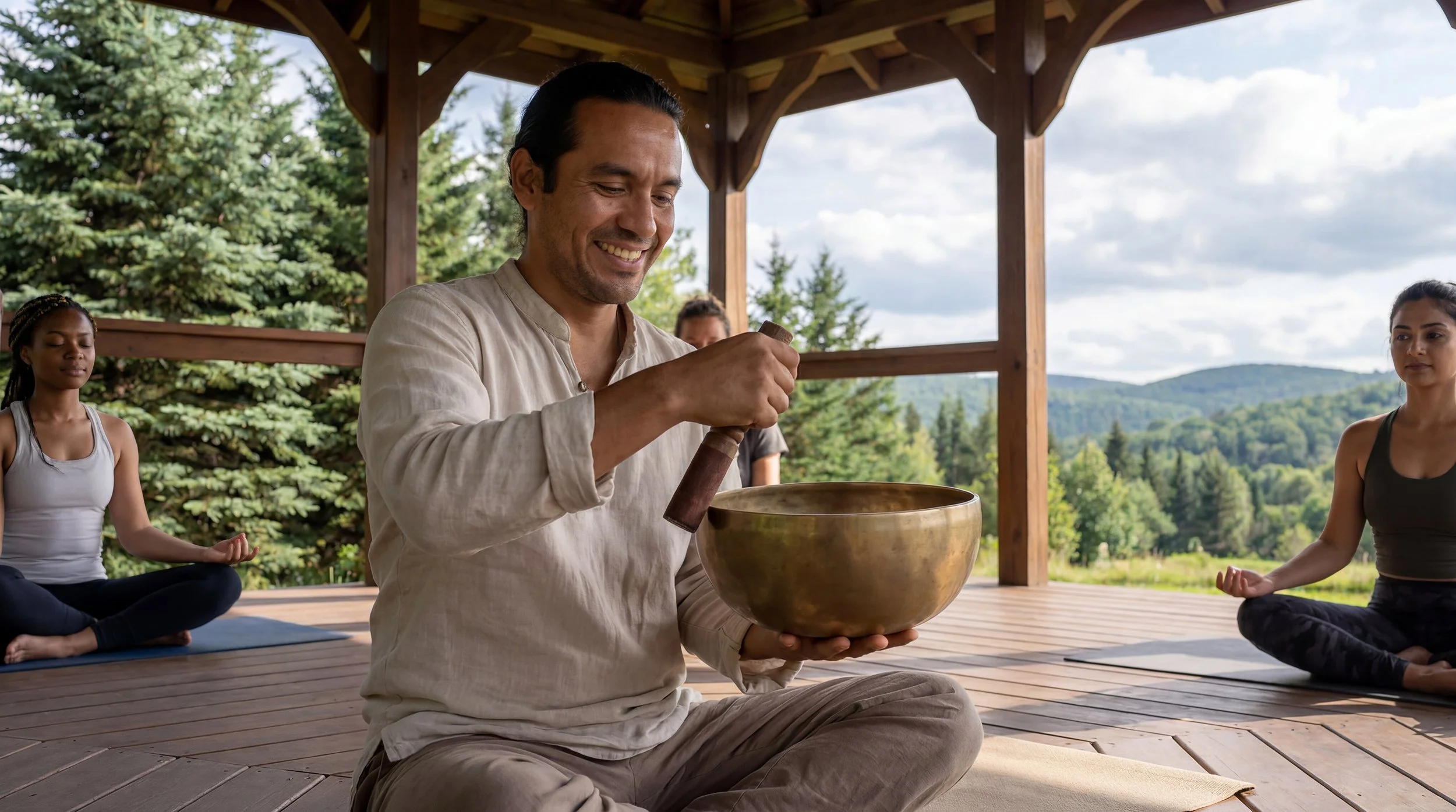
A single, quality Himalayan singing bowl is the most versatile entry point into instrument-based sound work for yoga teachers. It requires no musical knowledge to use effectively, it travels easily, and its overtone-rich tone produces an immediate, full-body response in most students.
The simplest application: strike the bowl once at the beginning of Savasana and let the tone ring out completely before you begin guiding the relaxation. Let the silence that follows the tone do the work. Students will settle into it naturally.
Tuning Forks for Private Sessions and Yoga Therapy
For yoga teachers who work with private clients or are on the path to yoga therapy certification, tuning forks offer a level of precision that group instruments cannot. Small, portable, and calibrated to specific therapeutic frequencies, tuning forks can be used directly on or near the body to induce a "still point" — a momentary suspension in which the nervous system has the opportunity to reset.
They are particularly valuable for working with students experiencing chronic tension, trauma-related holding patterns, or anxiety — populations that yoga therapists and advanced yoga teachers frequently encounter.
Koshi Chimes for Group Classes
If you want a sound element that requires even less technique than a singing bowl, Koshi chimes are an excellent option for group settings. Their gentle, cascading tones carry beautifully in a yoga space without overwhelming it. Many teachers use them at the very end of class as a quiet sonic closing — a few gentle chimes as students rest in Savasana. It takes ten seconds and leaves a lasting impression.
Designing a Class That Builds With Sound
Once you have individual tools in your toolkit, the next level is thinking about sound as an arc that runs through the entire class — not just a moment added at the beginning or end. A sound-integrated yoga class might move through these layers:
Opening: three rounds of humming or a grounding bīja to transition students from their day into the practice
During dynamic sequences: encourage audible exhales and open-vowel toning through effort — this regulates the nervous system during exertion and keeps students connected to breath
In long-held poses: offer a relevant bīja or invite students into silent internal toning, feeling the vibration in the area of the body being worked
At the peak of practice: a single, clear bowl tone to mark the transition toward cooling down — a sonic signal that the work of the body is done
In Savasana: sustained bowl playing or chimes, calibrated to the energy of the room
Closing: So hum or AUM to seal the practice and bring individual awareness back into collective resonance
This kind of intentional sound architecture doesn't require more class time — it uses the time you already have more skillfully. Most students won't consciously register how much sound is in the class. They'll just know they feel more deeply arrived at the end of it.
“🌿 Sound and Yoga Therapy: A Natural Partnership
For yoga teachers pursuing yoga therapy certification, sound integration is not just a teaching enhancement — it is a clinical skill. Therapeutic sound addresses the nervous system, the energetic body, and the emotional landscape in ways that movement alone cannot always reach. Students with chronic pain, trauma histories, anxiety disorders, and autoimmune conditions often respond to sound-based interventions with a speed and depth that surprises even experienced clinicians. PYI’s Sound Yoga training prepares yoga teachers and yoga therapists to use these tools with confidence and precision.”
The Most Important Thing: Start Before You Feel Ready
Every yoga teacher who now leads sound-rich classes will tell you the same thing: they started before they felt ready. They introduced So hum when they still felt a little self-conscious about it. They brought a singing bowl to class before they felt like they "knew enough."
Sound is not a subject you master and then teach. It is something you practice — alongside your students — and deepen over time.
What a Sound Yoga training gives you is the foundation to start confidently: the science to understand what you're doing, the tradition to know where it comes from, and the practical technique to do it well from the beginning. PYI's weekend Sound Yoga training compresses years of trial-and-error into a single focused weekend — so you leave with tools you can use on Monday morning.
Whether you are completing your RYT 200 and looking to differentiate your teaching from the start, building toward your RYT 500 with a therapeutic focus, or deepening your practice toward IAYT yoga therapy certification — sound belongs in your toolkit.
The training is available live online nationwide, with a Saturday in-person intensive in the Hudson Valley in 2026. It earns Yoga Alliance continuing education hours (CEUs), IAYT Applied Professional Development (APD) hours, and 25 credit hours toward PYI's full yoga therapy certification program.
“→ Ready to Bring Sound Into Your Teaching? Start This Weekend.
PYI’s Sound Yoga training gives yoga teachers the science, tradition, and hands-on technique to incorporate sound confidently and immediately. One weekend. Live online nationwide — plus a Saturday in-person intensive in the Hudson Valley in 2026. Yoga Alliance CEUs, IAYT APD hours, and 25 credit hours toward yoga therapy certification. No musical experience required. Enroll now.”
Interested in deepening your knowledge of sound work in an introductory course inspired by the yoga tradition? Check out our annual Sound Yoga Training here.
Sound Healing for Yoga Teachers: Why a Sound Bath Training Is the Most Powerful Tool You're Not Using Yet
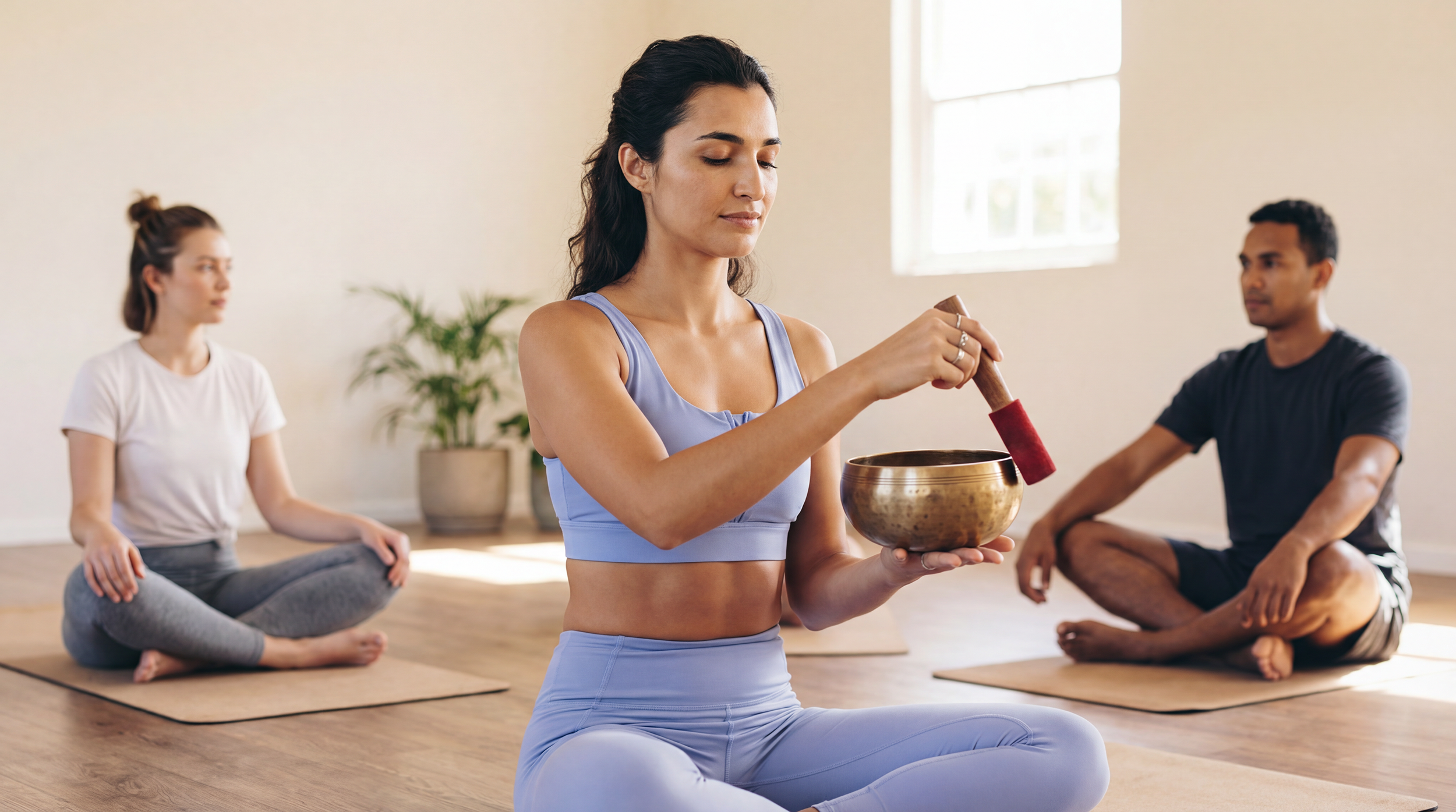
You've built a solid yoga practice. Your students trust you. You're a skilled, caring teacher. And yet — if you've ever watched someone settle into Savasana while a singing bowl rings and seen their whole body exhale in a way that three hours of asana couldn't quite reach, you already know that something is happening in the room that postures alone can't explain.
That something is sound.
Sound healing is one of the fastest-growing areas in yoga and integrative wellness — and for good reason. It works. Quickly. Measurably. In ways that science is increasingly able to explain and that practitioners have understood for thousands of years.
For yoga teachers looking to expand their toolkit, deepen their offering, and stand out in a crowded market, a Sound Yoga training is one of the highest-return certifications you can add. And for those on the path to yoga therapy certification, it is not just an elective — it is a clinical skill.
At Prema Yoga Institute, our weekend Sound Yoga training is open to yoga teachers, wellness professionals, and curious practitioners at all levels. It earns Yoga Alliance continuing education hours (CEUs), counts as Applied Professional Development (APD) hours toward IAYT yoga therapy certification, and applies 25 hours directly toward PYI's full yoga therapy certification program.
The training is offered live online with an optional Saturday in-person intensive in the Hudson Valley — making it accessible whether you prefer learning from home or want the full embodied experience of instruments and group sound in person.
“🎵 What Makes Sound Yoga Different From a Regular Sound Bath?
A sound bath is an experience. Sound Yoga training is an education. In PYI’s weekend program, you learn the science, the tradition, and the technique behind why sound works — and how to apply it intentionally in your classes, private sessions, and yoga therapy practice. You leave with tools, not just feelings.”
Why Sound Works: The Science Behind the Singing Bowl
Sound is not soft science. The physiological effects of therapeutic sound are well-documented, and understanding them makes you a more effective, confident practitioner.
Every structure in the body — cells, tissues, organs, even thoughts — has a natural resonant frequency. When stress, trauma, or illness disrupts that frequency, the result is dis-ease in the truest sense: the body is out of its natural alignment. Sound healing works by introducing organized, intentional vibration that invites the body back toward coherence.
Here's what the research shows sound actually does in the body:
Stimulates the vagus nerve: which carries 75% of all parasympathetic nervous system activity — sending a direct signal of safety and calm to the brain and body
Increases nitric oxide (NO): by up to 15–20 times through humming and toning alone. Nitric oxide signals the body to enter parasympathetic mode, improves vascular flow, strengthens the immune system, and enhances mental clarity
Organizes neural activity: helping the brain shift out of stress states and into relaxed, coherent patterns
Boosts endorphins and lowers cortisol: the stress hormone that drives anxiety, inflammation, and immune suppression
Leverages entrainment: the phenomenon where a less dominant vibration naturally synchronizes with a more powerful one — meaning your students' nervous systems literally attune to the healing frequencies you introduce
For yoga teachers, this isn't abstract theory. It is the mechanism behind why your students feel so profoundly different after a sound-enhanced class — and why adding these tools makes you measurably more effective.
What You Learn in PYI's Weekend Sound Yoga Training
PYI's Sound Yoga training is designed to be immediately practical. You don't need to be a musician. You don't need prior sound healing experience. You need curiosity and a commitment to serving your students at a higher level.
In a single focused weekend — available live online with an optional Saturday in-person intensive in the Hudson Valley — you will learn:
The science of sound therapy: acoustics, entrainment, resonance, and how sound influences the human nervous system
Mantra and seed syllables (bījas): how to use traditional yogic sound formulas to balance the chakras and organize the energetic body
Toning and the healing voice: practical vocal techniques that anyone can use — no singing experience required
Himalayan bowls, Koshi chimes, and tuning forks: introduction to the instruments, how to play them, and how to build a sound journey
Sound bath structure: how to design and lead a complete sound healing experience for groups or private clients
Integration with yoga classes: how to weave sound into your existing teaching without overhauling your entire approach
“📌 Certification Credentials You Earn
PYI’s Sound Yoga training earns Yoga Alliance continuing education hours (CEUs) toward your RYT renewal, qualifies as Applied Professional Development (APD) with IAYT toward yoga therapy certification, and counts as 25 direct hours toward PYI’s full IAYT-accredited yoga therapy certification program. It is also offered in partnership with The City College of New York (CUNY).”
Who This Training Is For
PYI's Sound Yoga weekend training is the right fit if you are:
A yoga teacher: (RYT 200 or above) looking to expand your offerings, earn CEUs, and give your students a deeper experience of relaxation and healing
A wellness professional: — therapist, coach, nurse, social worker, or integrative health practitioner — who wants to incorporate evidence-based sound tools into your work
On the path to yoga therapy certification: and looking for a powerful elective that counts toward both Yoga Alliance and IAYT credentials
A curious practitioner: who has experienced sound healing and wants to understand it deeply enough to share it
All of PYI's programs are offered fully online with live faculty sessions, making them accessible to yoga teachers and wellness professionals throughout New York, New Jersey, Connecticut, and nationwide. In 2026, PYI is also offering a Saturday in-person intensive in the Hudson Valley for those who want to experience the instruments and the collective energy of group sound practice firsthand.
“→ Ready to Add Sound Healing to Your Yoga Teaching?
PYI’s weekend Sound Yoga training is enrolling now. One weekend. Yoga Alliance CEUs. IAYT APD hours. 25 credit hours toward yoga therapy certification. Live online nationwide — plus a Saturday in-person intensive in the Hudson Valley in 2026. All levels and backgrounds welcome.”
Interested in deepening your knowledge of sound work in an introductory course inspired by the yoga tradition? Check out our annual Sound Yoga Training here.