

Mantras, Bīja Syllables, and the Science of Sound: What Yoga Teachers Learn in Sound Yoga Training
Before there were singing bowls. Before there were playlists. Before there were Spotify stations labeled "528 Hz Healing Frequency" — there was mantra.
For thousands of years, across every tradition that placed yoga at its center, sound was understood as one of the most direct paths to transformation available to human beings. Not because it was mystical. But because it worked — consistently, measurably, and in ways that modern neuroscience and physiology are now helping us understand.
For yoga teachers and wellness professionals looking to deepen their practice and expand what they can offer students, understanding the language of sound — mantras, bīja syllables, and the principles of Nada Yoga — is one of the most powerful skills you can develop. It is also one of the most underutilized.
Here's what you need to know.
What Is Nada Yoga — and Why Does It Matter for Yoga Teachers?
Nada Yoga — the yoga of sound — is one of the oldest branches of the yoga tradition. Its central premise is that all of existence is made up of sound vibrations, called nāda, and that working skillfully with sound is therefore a direct path to understanding — and influencing — the nature of reality, including the reality of the body and mind.
In practical terms for yoga teachers, Nada Yoga offers a framework for understanding why chanting, toning, and instrument-based sound healing produce such consistent, profound results in students. It's not placebo. It's physics, physiology, and thousands of years of refined practice.
Sound Yoga training at PYI is rooted in the Nada Yoga tradition and bridges it with contemporary research — so you understand not just what to do, but why it works.
Mantra: Sound as Medicine
The word mantra comes from two Sanskrit roots: man- ("to think") and -tra ("protecting" or "liberating"). Mantras are not prayers in the conventional sense — they are precision sound tools, designed to focus and organize the mind while producing specific physiological effects in the body.
The use of mantra in the Hindu and Nada Yoga traditions is one of the longest-running examples of sound as medicine in human history. Research on repetitive vocalization shows that chanting activates the vagus nerve, reduces cortisol, synchronizes brainwave activity, and creates measurable states of coherence in the nervous system.
In PYI's Sound Yoga training, yoga teachers and wellness professionals learn how to use specific mantras appropriately and effectively — including how to introduce them to students who may have no prior relationship with Sanskrit or yogic tradition.
So Hum: The Most Accessible Starting Point
The mantra So hum — meaning "I am that" or "I am she/he/it" — is one of the most universally accessible entry points into mantra practice. It requires no belief system, no prior experience, and no particular cultural background. It simply coordinates breath with sound, settling the mind and connecting the practitioner to something larger than their own internal noise.
It is also one of the most effective tools a yoga teacher or yoga therapist can offer a stressed, anxious, or overwhelmed student.
Bīja Syllables: Seed Sounds for the Chakras
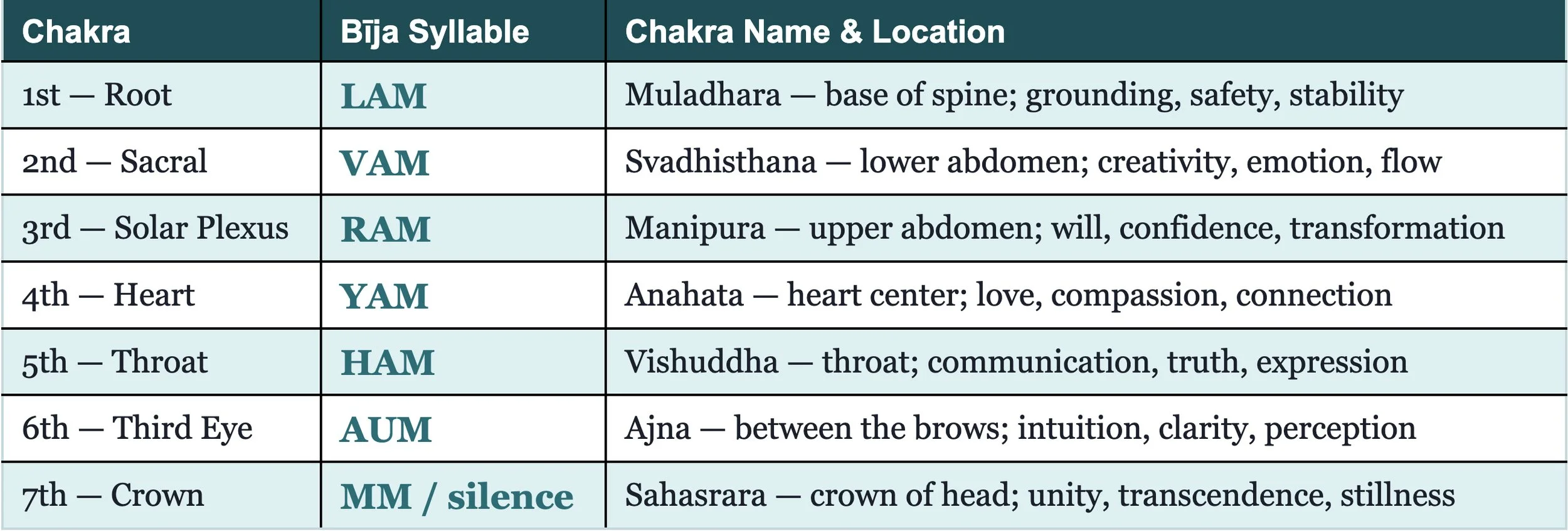
If mantras are complete sentences, bījas (seed syllables) are single, concentrated seeds of sound — brief, powerful, and precise. Each bīja is associated with one of the seven main chakras (energetic centers), and its repetition is said to directly retune that center's vibratory frequency.
For yoga teachers, bījas are enormously practical. They can be offered at the end of a class, embedded in a meditation, used during restorative poses, or incorporated into a sound bath sequence. They require no instruments, no music training, and no elaborate setup — just your voice and intention.
The Seven Chakra Bījas
How Mantras and Bījas Fit Into Your Teaching — Right Now
One of the most common questions in PYI's Sound Yoga training is: "How do I actually use this without it feeling forced or out of place?" The answer is: start small, start genuine.
End a restorative class: with three rounds of So hum, synchronized with the inhale and exhale
Open a meditation: with the bīja for the heart chakra (YAM) to set an intention of compassion and openness
Use LAM: at the beginning of a grounding sequence for Vāta students or anyone presenting with anxiety
Teach the meaning: — even one sentence of context transforms a chant from a strange noise into a doorway
In PYI's weekend Sound Yoga training, yoga teachers practice using these tools in real time — with feedback, support, and the opportunity to feel their effects before you're asked to share them with anyone else. The training is available live online nationwide, with a Saturday in-person intensive in the Hudson Valley in 2026 for those who want to work directly with the instruments in a group setting.
“→ Learn Mantras, Bījas, and Sound Healing in PYI’s Weekend Training
PYI’s Sound Yoga training teaches the full language of therapeutic sound — from Nada Yoga philosophy to practical instrument technique. One weekend. Live online nationwide, plus a Saturday in-person intensive in the Hudson Valley in 2026. Yoga Alliance CEUs, IAYT APD hours, and 25 credit hours toward yoga therapy certification.”
Interested in deepening your knowledge of sound work in an introductory course inspired by the yoga tradition? Check out our annual Sound Yoga Training here.